Derisking anti-CD20: the ADIOS-IM study

Barts-MS rose-tinted-odometer: ★★★★★ (a London Grey day #666677)

Can we use an anti-CD20 therapy as an immune constitution therapy (IRT), i.e. 2 years of treatment followed by no treatment unless there is EIDA (evidence of inflammatory disease activity)? This strategy is not new to the field of MS; this is how we use alemtuzumab, cladribine and AHSCT. So why not with ocrelizumab, ofatumumab or rituximab?

The anti-CD20-IRT question really needs an answer. However, many of my colleagues are nervous about not treating pwMS continuously and would therefore prefer to use adaptive dosing of anti-CD20s based on B-cell, or memory B-cell, reconstitution. This is why we proposed doing the ADIOS study (adaptive ocrelizumab dosing study) in 2019 and were in the process of getting this study designed and funded prior to COVID-19. 

However, since COVID-19 and the introduction of COVID-19 vaccines have spotlighted the long-term safety signals associated with continuous anti-CD20 therapy and their associated poor vaccine responses we now want to redesign the study. We now want the study to be focused on safety and to add another arm to test using anti-CD20 therapy as induction therapy for 2 years and then following it with a derisking strategy using one of the licensed immunomodulatory or low-risk maintenance therapies, i.e. interferon-beta, glatiramer acetate, teriflunomide or dimethyl fumarate (DMF). This is the so-called IM or induction-maintenance arm.

The proposed primary outcome will be serious Infections, which are those requiring hospitalisation. Secondary outcomes will include the development of hypogammaglobulinaemia, antibiotic and antiviral drug usage as a surrogate for infections, vaccine responses, days off work and healthcare utilisation. With regard to efficacy, we propose assessing change in T2-lesion volume or number and relapses for inflammation and brain volume change and disability progression as end-organ damage markers. 

This study will need to be pragmatic and run through a registry, for example, the UK’s OPTIMISE pharmacovigilance platform. We also propose doing some nested or add-on studies in cohorts to do specific vaccine, biomarker, immunology and virology studies. These add-on studies will provide more data on each of the arms being used in the ADIOS-IM study.

Some questions for any readers who are anti-CD20 therapies. Would you volunteer to participate in this study? If there are any HCPs reading this post do you think we have clinical equipoise to do this study or have you already adopted one or more of these strategies to derisk anti-CD20 therapy already in your clinical practice? 

Another potential advantage of this study, apart from making your MS treatment safer, is the potential cost-saving in the long term for the NHS or your health insurance provider.

Conflicts of Interest

MS-Selfie Newsletter  /  MS-Selfie Microsite

Preventive Neurology

Twitter   /  LinkedIn  /  Medium

General Disclaimer: Please note that the opinions expressed here are those of Professor Giovannoni and do not necessarily reflect the positions of the Barts and The London School of Medicine and Dentistry nor Barts Health NHS Trust and are not meant to be interpreted as personal clinical advice.

Kind of Blue

Barts-MS rose-tinted-odometer: zero-★s (Feeling ‘Kind of Blue’ for a Saturday, midnight blue #191970)

We have known for some time now that pwMS on DMTs who get COVID-19 seem to be at no greater risk of severe COVID-19 and death compared to the general population with the exception of pwMS on anti-CD20 therapies. This implies that anti-CD20 therapies either impact preexisting cross-reactive protective immunity from other community-acquired coronavirus infections and/or antibody responses during COVID-19, which have been now shown to prevent severe infection and death. I think there is now ample evidence to support both of these explanations.

People who had the original SARS in 2003 have been shown to have broad anti-coronavirus immunity and make very good neutralising antibodies to SARS-CoV-2, which is boosted to very high levels in response to COVID-19 vaccination. Similarly, immunoglobulin formulations made from the plasma of blood donors prior to COVID-19 is able to neutralise SARS-CoV-2. Therefore preexisting immunity to other coronaviruses is helpful and this will be blunted by being on an anti-CD20 therapy, particularly if you have been on the anti-CD20 therapy for a prolonged period of time. This observation goes beyond COVID-19 and explains why the risk of infections in people on long-term anti-CD20 therapy increases over time.

It has also recently been shown that the delayed development of neutralising anti-SARS-CoV-2 antibodies is strongly associated with death in patients with COVID-19 in intensive care  (Lucas et al. Nat Med. 2021 Jul;27(7):1178-1186). Therefore contrary to original hypotheses that B-cell responses were not necessary for recovery from COVID-19, it is now clear that antibody responses to SARS-CoV-2 are important in protecting you against a poor COVID-19 outcome. This now explains why people on anti-CD20 therapies are more likely to have severe COVID-19 and I suspect more likely to succumb to the infection.

I discuss the clinical implications of this and other findings for the management of MS in my latest MS-Selfie Newsletter ‘Anti-CD20 Kool-Aid and COVID-19 vaccines’ (9-Sept-2021). 

Kind of Blue: Please take some time off today to remember and reflect on the people who lost their lives in the 11-September-2001 attacks in New York and Washington and subsequently in the world’s response to these attacks. I am going to listen to Mile Davis’ album, ‘Kind of Blue’ when I do this.  

Lucas et al. Delayed production of neutralizing antibodies correlates with fatal COVID-19. Nat Med. 2021 Jul;27(7):1178-1186. 

Recent studies have provided insights into innate and adaptive immune dynamics in coronavirus disease 2019 (COVID-19). However, the exact features of antibody responses that govern COVID-19 disease outcomes remain unclear. In this study, we analyzed humoral immune responses in 229 patients with asymptomatic, mild, moderate and severe COVID-19 over time to probe the nature of antibody responses in disease severity and mortality. We observed a correlation between anti-spike (S) immunoglobulin G (IgG) levels, length of hospitalization and clinical parameters associated with worse clinical progression. Although high anti-S IgG levels correlated with worse disease severity, such correlation was time dependent. Deceased patients did not have higher overall humoral response than discharged patients. However, they mounted a robust, yet delayed, response, measured by anti-S, anti-receptor-binding domain IgG and neutralizing antibody (NAb) levels compared to survivors. Delayed seroconversion kinetics correlated with impaired viral control in deceased patients. Finally, although sera from 85% of patients displayed some neutralization capacity during their disease course, NAb generation before 14 d of disease onset emerged as a key factor for recovery. These data indicate that COVID-19 mortality does not correlate with the cross-sectional antiviral antibody levels per se but, rather, with the delayed kinetics of NAb production.

Conflicts of Interest

MS-Selfie Newsletter  /  MS-Selfie Microsite

Preventive Neurology

Twitter   /  LinkedIn  /  Medium

General Disclaimer: Please note that the opinions expressed here are those of Professor Giovannoni and do not necessarily reflect the positions of the Barts and The London School of Medicine and Dentistry nor Barts Health NHS Trust and are not meant to be interpreted as personal clinical advice. 

Clash of the Titans: the HILO study

Barts-MS rose-tinted-odometer: ★★★ (I am seeing blue and Spanish yellow today) 
Roche blue (#0066CC) & Novartis Spanish Yellow (#F7B516)

Yes, I really do think that intrathecal (within the meninges that cover the brain and spinal cord) or CNS resident B-cells and plasma cells are pathogenic in MS. In other words, the cytokine or chemicals B-cells and plasma cells produce, in particular their antibodies, are what is driving some of the pathologies of smouldering MS. The evidence to support this hypothesis is well rehearsed on this blog and is the reason why we are testing high-dose ocrelizumab (more CNS penetrant) vs. standard-dose ocrelizumab (less CNS penetrant) against each other in two head-2-head studies. It is also the reason we are testing cladribine’s (CLADRIPLAS and CLAD-B) and ixazomib’s (SIZOMUS) effects in intrathecal B and plasma cell markers. Yes, I really do think we need to scrub the CNS clean of B-cells, plasma cells and their products, in particular the oligoclonal IgG bands. 

I am therefore proposing a new study; the HIgh-dose versus LOw-dose anti-CD20 study or HILO Study. 

In this study, I propose testing high-dose or double-dose ocrelizumab vs. standard or intermediate-dose ocrelizumab vs. low-dose ofatumumab against each other over two years and measure their impact on end-organ damage markers (slowly expanding lesions and brain volume loss) and on CSF markers of B-cell, plasma cell and microglial activity. The latter will include free kappa and lambda immunoglobulin light chains, OCBs, soluble CD14, etc. This will answer at least from a biomarker question whether or not we need CNS penetration of anti-CD20 monoclonal antibodies to target this component of smouldering MS. The following would also answer the question of whether or not you as a person with MS would want to be treated with high-dose or low-dose anti-CD20 therapy? 

Would you want to be randomised into this study?

This study would be a clash of the titans; Roche vs. Novartis. Who would win? It really is not that important as Novartis is a major shareholder in Roche and hence when Roche makes a profit so does Novartis. The real winners will be people with MS, the data will allow them to make an informed decision about whether or not they want to go beyond NEIDA (no evident inflammatory disease activity) and be on a treatment that tackles the smouldering B-cell and plasma-cell driven processes within their brains and spinal cords. 

SHOULD WE DO THE HILO STUDY? 

Conflicts of Interest

MS-Selfie Newsletter  /  MS-Selfie Microsite

Preventive Neurology

Twitter   /  LinkedIn  /  Medium

General Disclaimer: Please note that the opinions expressed here are those of Professor Giovannoni and do not necessarily reflect the positions of the Barts and The London School of Medicine and Dentistry nor Barts Health NHS Trust and are not meant to be interpreted as personal clinical advice. 

Purple haze

Barts-MS rose-tinted-odometer: ★★ (Purple Haze Friday #7D7098; looking forward to the weekend)

It is quite amazing how large and extensive the focal inflammatory lesion blindspot or scotoma is in the field of MS. I was on a call with a few American neurologists last week and they were saying how anti-CD20 therapy has transformed their MS practice. One neurologist claimed that 4 out of 5 of their patients were now going onto ocrelizumab or ofatumumab. He even said that ofatumumab will become the new Copaxone; i.e. no blood monitoring and very safe. Do you agree? When I reminded this neurologist of the end-organ damage data, i.e. brain volume loss, and the progression independent of relapse data in relation to anti-CD20 therapies he dismissed me saying that these patients were free of relapses and their MRI’s were quiet so he had done his job. 

And herein lies the problem, the wider MS community including MS experts are not prepared to look beyond relapses and MRI activity; for them this is MS. In other words, if you render people relapse and MRI activity free then you have treated their MS. However, if you scratch the surface this is clearly not the case. If relapses were MS then they would predict long term outcome, but they don’t except when you are on therapy. According to the Prentice criteria that define a surrogate endpoint for relapses to be MS they need to predict outcome regardless of treatment. This is why relapses cannot be MS; relapses and their MRI equivalent (focal lesions) simply represent the immune system’s response to what is causing the disease or the real MS. 

The data set below from the MS-Base register supports this proposition; i.e. off-therapy relapses do not predict long-term outcome, unlike on-therapy relapses. This point is so fundamental to understanding the real MS that most people can’t get their heads around it. 

So what does this mean to you if you have MS? It means that if you have no evident inflammatory disease activity (NEIDA), and are relapse-free and MRI-activity free, it doesn’t mean your MS is necessarily under control. In other words, you could still be losing brain volume at double the rate of what is expected for your age and you could still be worsening. This is why we mustn’t be lulled into a sense of false security that we have cracked MS with our current therapies, in particular with the anti-CD20 therapies. We really need to go beyond NEIDA and target smouldering MS with new add-on strategies. 

I hope all this makes sense? I have asked you before, would you rather be NEIDA or NEIDA and NEO-EOD (no evident ongoing end-organ damage)? The challenge for the MS community is to shift our focus to the latter target. 

image
Figure from the Ann Neurol. Contribution of on- and off-therapy annualized relapse rate (ARR) to 10-year median Expanded Disability Status Scale (EDSS) changes (95% confidence interval). Here the ARR is normalized to 1. This figure shows the results of 2 adjusted quantile median regression analyses. All analyses were adjusted for gender, age at baseline, disease duration, the proportion of follow-up on first-line disease-modifying therapy (DMT), pregnancies, first DMT identity, baseline EDSS score, and clinic country. Subanalysis 1 (S1) includes all 2,466 patients from the primary analysis. Subanalysis 2 (S2) only models those patients who were able to contribute to both on-treatment and off-treatment epochs (n = 1,475). This figure demonstrates that on-treatment relapses have a profound effect on long-term EDSS increases, whereas off-treatment relapses have a marginal effect on disability outcomes.

Jokubaitis et al. Predictors of long-term disability accrual in relapse-onset multiple sclerosis. Ann Neurol. 2016 Jul;80(1):89-100. 

Objective: To identify predictors of 10-year Expanded Disability Status Scale (EDSS) change after treatment initiation in patients with relapse-onset multiple sclerosis.

Methods: Using data obtained from MSBase, we defined baseline as the date of first injectable therapy initiation. Patients need only have remained on injectable therapy for 1 day and were monitored on any approved disease-modifying therapy, or no therapy thereafter. Median EDSS score changes over a 10-year period were determined. Predictors of EDSS change were then assessed using median quantile regression analysis. Sensitivity analyses were further performed.

Results: We identified 2,466 patients followed up for at least 10 years reporting post-baseline disability scores. Patients were treated an average 83% of their follow-up time. EDSS scores increased by a median 1 point (interquartile range = 0-2) at 10 years post-baseline. Annualized relapse rate was highly predictive of increases in median EDSS over 10 years (coeff = 1.14, p = 1.9 × 10(-22) ). On-therapy relapses carried greater burden than off-therapy relapses. Cumulative treatment exposure was independently associated with lower EDSS at 10 years (coeff = -0.86, p = 1.3 × 10(-9) ). Furthermore, pregnancies were also independently associated with lower EDSS scores over the 10-year observation period (coeff = -0.36, p = 0.009).

Interpretation: We provide evidence of long-term treatment benefit in a large registry cohort, and provide evidence of long-term protective effects of pregnancy against disability accrual. We demonstrate that high annualized relapse rate, particularly on-treatment relapse, is an indicator of poor prognosis. Ann Neurol 2016;80:89-100.

Conflicts of Interest

Preventive Neurology

Twitter

LinkedIn

Medium

General Disclaimer: Please note that the opinions expressed here are those of Professor Giovannoni and do not necessarily reflect the positions of the Barts and The London School of Medicine and Dentistry nor Barts Health NHS Trust and are not meant to be interpreted as personal clinical advice. 

Do you want to be treated with low-dose anti-CD20 therapy?

Barts-MS rose-tinted-odometer: ★★★★★ (rose-red; a climbing rose with thorns)

I have moved my treatment goal beyond NEIDA (no evident inflammatory disease activity) for my patients with MS. The new focus is on preventing end-organ damage. To achieve this we need to take off the blinkers that the Pharma industry has blinded us with. Our treatment target has to be smouldering MS, i.e. stopping disability progression, normalising brain volume loss, flattening neurofilament levels, stop slowly expanding lesions from getting bigger, clearing the CSF of oligoclonal bands and if possible promoting repair and recovery of the nervous system. 

What good is to be free of relapses and focal MRI activity if you are getting worse? This is why the concept of using low dose anti-CD20 therapy is so flawed. It is clear that study subjects exposed to lower doses of ocrelizumab in the phase 3 trials did as well as those exposed to higher doses in relation to relapses and MRI activity, but not in relation to worsening disability (see slideshow below). 

From this post-hoc analysis, it is clear that you need higher, and not lower, doses of anti-CD20 therapy at least initially as an induction strategy to purge the various B-cell compartments. We hypothesise these compartments house memory B-cells, which may be an important sanctuary for latent EBV and/or the highly autoreactive population of B-cells that drive and maintain the MS-state. This population of cells may reside in the deep tissues and/or the central nervous system. This is why we and others are testing CNS penetrant anti-B-cell strategies (ixazomib, cladribine, BTK inhibitors, etc.), i.e. we are going beyond the peripheral B-cell target. 

However, I have hypothesized that once you have purged these compartments, say after 2 years of treatment you may not need to maintain such high doses of anti-CD20 therapy that will then suppress normal B-cell biology and immune responses, which result in long term complications. This is why I have proposed using ocrelizumab as an immune reconstitution therapy, i.e. high-dose upfront followed by no treatment and wait to see if MS remains in remission or disease-activity returns requiring additional courses. The latter is what we are proposing to do in the ADIOS study. 

Even better would be two years of induction therapy with high-dose ocrelizumab followed by a maintenance therapy such as teriflunomide, leflunomide, IMU-838 (vidofludimus) or ASLAN003 (selective second-generation DHODH inhibitors), HAART (highly active antiretrovirals), famciclovir or another anti-EBV viral agent. 

The hypothesis is to allow B-cell reconstitution after anti-CD20 therapy in the presence of an antiviral agent to prevent EBV reactivation and reinfection of new memory B cells. By doing this you will also be derisking the long-term immunosuppression associated with anti-CD20 therapies and prevent the development of hypogammaglobulinemia. This strategy will also allow patients to respond to vaccines.

However, if you want lower dose anti-CD20 therapy you will be able to start Ofatumumab very soon. Please remember ofatumumab was vastly superior to teriflunomide in suppressing relapses and MRI activity (Pharma’s blinkers) but was not superior to  teriflunomide at slowing down brain volume loss in year two of the ASCLEPIOS I and II clinical trials (NCT02792218 and NCT02792231). Why? 

The following is the fundamental question you should ask yourself.

So what would you choose your MS to be treated with; (1) low-dose anti-CD20, (2) high-dose anti-CD20, (3) high-dose anti-CD20 therapy followed by a maintenance treatment or (4) an immune-reconstitution therapy (cladribine, alemtuzumab or AHSCT)?

Sadly we can’t offer all of these choices to all of our patients with MS in the current NHS treatment landscape. 

Figure from the NEJM.

Hauser et al. Ofatumumab versus Teriflunomide in Multiple Sclerosis. N Engl J Med. 2020 Aug 6;383(6):546-557. 

Background: Ofatumumab, a subcutaneous anti-CD20 monoclonal antibody, selectively depletes B cells. Teriflunomide, an oral inhibitor of pyrimidine synthesis, reduces T-cell and B-cell activation. The relative effects of these two drugs in patients with multiple sclerosis are not known.

Methods: In two double-blind, double-dummy, phase 3 trials, we randomly assigned patients with relapsing multiple sclerosis to receive subcutaneous ofatumumab (20 mg every 4 weeks after 20-mg loading doses at days 1, 7, and 14) or oral teriflunomide (14 mg daily) for up to 30 months. The primary end point was the annualized relapse rate. Secondary end points included disability worsening confirmed at 3 months or 6 months, disability improvement confirmed at 6 months, the number of gadolinium-enhancing lesions per T1-weighted magnetic resonance imaging (MRI) scan, the annualized rate of new or enlarging lesions on T2-weighted MRI, serum neurofilament light chain levels at month 3, and change in brain volume.

Results: Overall, 946 patients were assigned to receive ofatumumab and 936 to receive teriflunomide; the median follow-up was 1.6 years. The annualized relapse rates in the ofatumumab and teriflunomide groups were 0.11 and 0.22, respectively, in trial 1 (difference, -0.11; 95% confidence interval [CI], -0.16 to -0.06; P<0.001) and 0.10 and 0.25 in trial 2 (difference, -0.15; 95% CI, -0.20 to -0.09; P<0.001). In the pooled trials, the percentage of patients with disability worsening confirmed at 3 months was 10.9% with ofatumumab and 15.0% with teriflunomide (hazard ratio, 0.66; P = 0.002); the percentage with disability worsening confirmed at 6 months was 8.1% and 12.0%, respectively (hazard ratio, 0.68; P = 0.01); and the percentage with disability improvement confirmed at 6 months was 11.0% and 8.1% (hazard ratio, 1.35; P = 0.09). The number of gadolinium-enhancing lesions per T1-weighted MRI scan, the annualized rate of lesions on T2-weighted MRI, and serum neurofilament light chain levels, but not the change in brain volume, were in the same direction as the primary end point. Injection-related reactions occurred in 20.2% in the ofatumumab group and in 15.0% in the teriflunomide group (placebo injections). Serious infections occurred in 2.5% and 1.8% of the patients in the respective groups.

Conclusions: Among patients with multiple sclerosis, ofatumumab was associated with lower annualized relapse rates than teriflunomide. (Funded by Novartis; ASCLEPIOS I and II ClinicalTrials.gov numbers, NCT02792218 and NCT02792231.).

Conflicts of Interest

Preventive Neurology

Twitter

LinkedIn

Medium

General Disclaimer: Please note that the opinions expressed here are those of Professor Giovannoni and do not necessarily reflect the positions of the Barts and The London School of Medicine and Dentistry nor Barts Health NHS Trust.

Anti-CD20 more than just B-cell depletion

Barts-MS rose-tinted-odometer: ★★ (amber; a sleep deprived colour somewhere between yellow and orange)

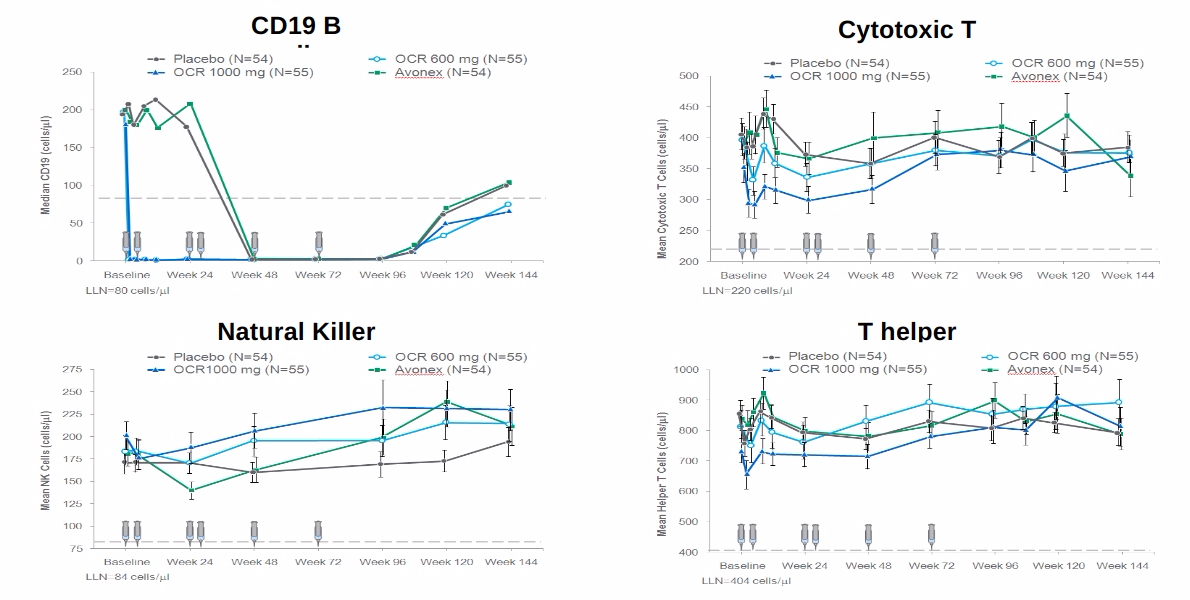
It has become clear that the anti-CD20 therapies are more than just anti-B-cell therapies. Minority populations of both CD4+ and CD8+ T-cells and NK-cells express CD20 and are depleted after both rituximab and ocrelizumab treatment. 

It looks as if ocrelizumab may be more effective in deleting this population of cells and may explain why herpes zoster or shingles is more common after ocrelizumab, compared to rituximab, than what you would expect based on its putative B-cell only targeting effect. The mild depletion of this population of cells may also explain why pwMS on ocrelizumab are at higher risk of getting COVID-19 and severe COVID-19

The study below shows that this population of cells express a so-called CTL or cytotoxic phenotype that fits in with the zoster and COVID-19 data. This also raises concerns that just maybe peripheral tumour immune surveillance is also compromised on anti-CD20 therapies. The tumour signal however is likely to be small as a large secondary cancer signal would likely have emerged already on the anti-CD20s.

More topical is the role these CD20-expressing T-cells play in vaccine responses. If they are important in vaccine immunity then patients with MS on anti-CD20 therapies who lack this population of T-cells may not develop adequate T-cell immunity in response to vaccination. We won’t have long to wait for the latter data as many immunology laboratories are busy trying to get their T-cell vaccine data out as soon as possible. 

So yes there is much more to the immunology of anti-CD20 therapy than simple B-cell depletion. Could the T-cell compartment targeted by anti-Cd20 therapies be as important or more important than the B-cell compartment? There is so much more to learn about how MS DMTs really work, in particular the anti-CD20 therapies. 

Boldrini et al. Cytotoxic profile of CD3+CD20+ T cells in progressive multiple sclerosis. Mult Scler Relat Disord. 2021 May 7;52:103013.

Recently, it was shown that highly effective anti-CD20 therapies used for MS patients not only deplete CD20+ B cells, but also a small subset of T cells expressing CD20 surface marker (CD3+CD20+ T cells). Here we demonstrated that, in progressive MS patients, CD3+CD20+ T cells share the ability to express cytotoxic factors such as perforin and serine-protease granzyme-B (GzmB), classically associated with CD8+ T cells functionality. Beyond it, cluster analyses show that a set of activation markers and transcriptional factors related with CD8 effector program are also expressed in CD3+CD20+ T cells. Further characterization of surface and functional markers from CD3+CD20+ T subsets may be helpful for development of new therapeutic strategies mainly for progressive MS patients, as well as for assessing pathophysiological effects of highly effective anti-CD20 therapies.

Conflicts of Interest

Preventive Neurology

Twitter

LinkedIn

Medium

General Disclaimer: Please note that the opinions expressed here are those of Professor Giovannoni and do not necessarily reflect the positions of the Barts and The London School of Medicine and Dentistry nor Barts Health NHS Trust.

Ocrelizumab: DODO vs. ADIOS, who will win?


Barts-MS rose-tinted-odometer: ★★

In response to a question over the weekend about what has happened to the DODO and ADIOS studies. Both are alive and kicking. The more insightful question would be ‘how can I support both the DODO (double-dose ocrelizumab study) and the ADIOS (adaptive dosing ocrelizumab study) studies?’.

Surely, the DODO and ADIOS studies are incompatible with each other scientifically? How can I, on the one hand, support a higher dose of ocrelizumab and on the other hand suggest reducing the dose in the longterm. The hypothesis is all about timing and how you use anti–CD20 therapies.

You need higher doses of anti-CD20 therapy initially as an induction strategy to purge the various B-cell compartments of memory B-cells, which house latent EBV and the highly autoreactive population of B-cells that drive and maintain the MS-state. This population of cells may reside in the deep tissues and/or the central nervous system, which is why we are also testing CNS penetrant anti-B-cell strategies, simultaneously. Time is short so we need to run trials in parallel.

However, once you have purged these compartments say after 2 years of treatment you don’t need to maintain such high-doses of anti-CD20 therapies that are then suppressing normal B-cell biology and immune responses, which result in longterm complications. This is why we want to use ocrelizumab as an immune reconstitution therapy, i.e. high-dose upfront followed by no treatment and wait to see if MS remains in remission or disease-activity returns requiring additional courses. The latter is one of the arms of our proposed ADIOS study. 

In reality, if we could convince a national funding agency, a pharma company or a wealthy philanthropist I would use anti-CD20 therapy as part of an induction-maintenance protocol. After two years of induction therapy with high-dose ocrelizumab, I would test different maintenance strategies in parallel. My agents of choice would be teriflunomide, leflunomide, IMU-838 (vidofludimus) or ASLAN003 (selective second-generation DHODH inhibitors), HAART (highly active antiretrovirals), famciclovir or another anti-EBV viral agent. The hypothesis is to allow B-cell reconstitution after anti-CD20 therapy in the presence of an anti-viral agent to prevent EBV reactivation and reinfection of new memory B cells. By doing this you will also be derisking the long-term immunosuppression associated with anti-CD20 therapies and prevent the development of hypogammaglobulinaemia. In addition, you will be allowing patients to respond to vaccines.

The problem with this trial proposal is the outcome measure; the power calculations are not trivial and the study would have to be very long. I also have reservations about whether or not the regulators will accept the induction maintenance strategy. Maybe we can sell it to them on safety, i.e. to prevent the development of hypogammaglobulinaemia and infections rather than on efficacy? If we go this route then there is only one agent we can use and that is teriflunomide, which is licensed to treat MS. As teriflunomide is coming off patent there is a chance the  NHS may be interesting in funding such a trial; i.e. it would save them money. This is something I am exploring as a proof-of-concept trial.  

The good news is that Roche-Genentech is testing the principles of the DODO study and announced at MSVirtual2020 two high-dose ocrelizumab trials (see below). These trials up the stakes in the anti-CD20 wars and I am confident that we need higher doses upfront to purge deep tissue and possibly CNS pools of B-cells. Please note that you don’t need higher doses of anti-CD20 therapy to suppress relapses and focal MRI activity you can do that with current or lower doses. I am confident both these studies will show that higher-dose ocrelizumab is superior to standard dose ocrelizumab on disability progression or smouldering MS, but not on focal inflammatory events. In relation to the latter, we have hit the ceiling already.

You need higher doses up-front to target the drivers of smouldering MS; i.e. disease progression independent of relapses, accelerated brain volume loss, slowly expanding lesions (SELs) and the subpial cortical lesions.  If these higher-dose studies are positive it will put clear daylight between ocrelizumab and the other anti-CD20 therapies and it would mean the ofatumumab and rituximab are currently being underdosed, at least initially in the first two years. But don’t we have a hint of this already? Ofatumumab was not better than teriflunomide at slowing down brain volume loss in year two of the ASCLEPIOS I and II clinical trials (NCT02792218 and NCT02792231) despite being superior to teriflunomide on relapses and MRI activity. The latter is more proof that focal inflammatory disease (relapses and MRI activity) is not MS but in response to what is causing the disease. The real MS is what causes smouldering pathology and end-organ damage.

DODO vs. ADIOS vs. iTeri: which one would I prioritise? Almost certainly iTeri; the iTeri trial makes the most sense in terms of our current understanding of the pathogenesis of MS, mode of action of anti-CD20 therapies and the long-term risks of chronic B-cell depletion.

Figure from the NEJM.

Hauser et al. Ofatumumab versus Teriflunomide in Multiple Sclerosis. N Engl J Med. 2020 Aug 6;383(6):546-557. 

Background: Ofatumumab, a subcutaneous anti-CD20 monoclonal antibody, selectively depletes B cells. Teriflunomide, an oral inhibitor of pyrimidine synthesis, reduces T-cell and B-cell activation. The relative effects of these two drugs in patients with multiple sclerosis are not known.

Methods: In two double-blind, double-dummy, phase 3 trials, we randomly assigned patients with relapsing multiple sclerosis to receive subcutaneous ofatumumab (20 mg every 4 weeks after 20-mg loading doses at days 1, 7, and 14) or oral teriflunomide (14 mg daily) for up to 30 months. The primary end point was the annualized relapse rate. Secondary end points included disability worsening confirmed at 3 months or 6 months, disability improvement confirmed at 6 months, the number of gadolinium-enhancing lesions per T1-weighted magnetic resonance imaging (MRI) scan, the annualized rate of new or enlarging lesions on T2-weighted MRI, serum neurofilament light chain levels at month 3, and change in brain volume.

Results: Overall, 946 patients were assigned to receive ofatumumab and 936 to receive teriflunomide; the median follow-up was 1.6 years. The annualized relapse rates in the ofatumumab and teriflunomide groups were 0.11 and 0.22, respectively, in trial 1 (difference, -0.11; 95% confidence interval [CI], -0.16 to -0.06; P<0.001) and 0.10 and 0.25 in trial 2 (difference, -0.15; 95% CI, -0.20 to -0.09; P<0.001). In the pooled trials, the percentage of patients with disability worsening confirmed at 3 months was 10.9% with ofatumumab and 15.0% with teriflunomide (hazard ratio, 0.66; P = 0.002); the percentage with disability worsening confirmed at 6 months was 8.1% and 12.0%, respectively (hazard ratio, 0.68; P = 0.01); and the percentage with disability improvement confirmed at 6 months was 11.0% and 8.1% (hazard ratio, 1.35; P = 0.09). The number of gadolinium-enhancing lesions per T1-weighted MRI scan, the annualized rate of lesions on T2-weighted MRI, and serum neurofilament light chain levels, but not the change in brain volume, were in the same direction as the primary end point. Injection-related reactions occurred in 20.2% in the ofatumumab group and in 15.0% in the teriflunomide group (placebo injections). Serious infections occurred in 2.5% and 1.8% of the patients in the respective groups.

Conclusions: Among patients with multiple sclerosis, ofatumumab was associated with lower annualized relapse rates than teriflunomide. (Funded by Novartis; ASCLEPIOS I and II ClinicalTrials.gov numbers, NCT02792218 and NCT02792231.).

CoI: multiple

Twitter: @gavinGiovannoni                                              Medium: @gavin_24211

#MSCOVID19: CATCH-22

Barts-MS rose-tinted-odometer: ★

I know it sounds like a cliche but Catch-22 would definitely be on my list of most impressionable books I read as a teenager.  I liked it because of its dark satirical humour, it was written in the third-person and it taught me how absurd war actually is. Catch-22 (and the Great Gatsby) also taught me if you love a book you should never watch the movie; the screenwriters, actors and directors can never do your imaginary characters justice. 

The book has become so influential that ‘Catch-22’ has become a noun and refers to a dilemma or difficult circumstance from which there is no escape because of mutually conflicting or dependent conditions. 

Although I am meant to be at home recovering from injuries I am doing some emails. Over the last few days, I have received numerous emails from patients and neurologists asking for advice about COVID-19/SARS-CoV-2  vaccines and DMTs and what am I telling my patients. One patient tells me that her neurologist referred her the excellent MS Society webpage for advice, but the site then referred her back to her neurologist for definitive advice. A Catch-22?

Some US neurologists have picked-up that my advice and position on vaccines and vaccine readiness has changed since I first started talking about this issue on the blog. They are correct, my position has changed. I always took the position that we should continue to manage MS the way we managed it before COVID-19 with certain caveats* around the risk of being exposed to SARS-CoV-2 and whether or not individuals could self-isolate or not, and that we should cross the vaccine bridge when it arrives. Now that the vaccines are arriving and the ambitious national roll-out suggests the whole country will be vaccinated within the next 6 months, advice has to be given and given quite quickly. 

In my opinion, all the COVID-19 vaccines that the UK Government has purchased can be used in people with MS regardless of whether or not they are on a DMT. This advice is based on the fact that the MHRA and other regulatory bodies have licensed or will license these vaccines because of their safety and efficacy profile in the general population. 

Importantly none of these vaccines is likely to be a ‘live viral vaccine’. There is some confusion around the Oxford-AstraZeneca vaccine that does use a chimpanzee adenovirus vector to deliver the immunogen to our cells so that the immunogen can be expressed. The virus in this vaccine is able to infect cells and express its relevant proteins, but because some of its genes for replication have been mutated it cannot replicate itself and cause ongoing infection. I am not sure how this vaccine will be classified by the MHRA or other regulatory authorities, but in my opinion, it is likely to be safe to use in pwMS. 

I say these vaccines are likely to be safe in pwMS. However, none of the COVID-19 vaccines has specifically been tested in pwMS so we have to extrapolate data from the general population data. There may be something we don’t know about having MS that predisposes pwMS to some rare complications. However, based on other vaccines that have been used in MS this is very unlikely. 

It is clear that being on some immunosuppressive DMTs may reduce your chances of responding adequately to the vaccine and hence being fully immune to infection from wild-type SARS-CoV-2. Until we do detailed immunological studies in pwMS on each DMT we won’t be able to answer specific questions about each DMT with certainty. 

Interferon-beta , glatiramer acetate and immune reconstitution therapies

In general being on interferon-beta and glatiramer acetate, immunomodulatory DMTs, are unlikely to interfere with vaccine responses. Similarly, if you have had one of the immune reconstruction therapies, such as alemtuzumab, cladribine, mitoxantrone or HSCT in the past and have reconstituted your peripheral immune system you should respond to the vaccines. If on the other hand, you have not had completely reconstitution of your immune system you may still consider having the vaccine, but the immune response may be blunted. Waiting for immune reconstitution or having the vaccine now will be a trade-off between wanting to protect yourself now or waiting months when the pandemic may be almost over. Please note vaccination is not only about you, but slowing and preventing transmission of the virus in the general population, which is a factor you may want to consider. This may relevant, for example, if you want to see unvaccinated vulnerable relatives or if you want to travel to parts of the world with a delayed vaccination programme.  

Fumarates, teriflumide and natalizumab

If you are fumarates (DMF,  diroximel fumarate), teriflunomide or natalizumab, based on other vaccine studies, COVID-19 vaccine responses are likely to be reasonably preserved. Therefore there is no need to stop these DMTs or delay getting a vaccine if you are on these treatments. 

S1P modulators

For the so-called S1P modulators (fingolimod, siponimod, ozanimod and ponesimod) vaccine responses are likely to be blunted, but whether or not the blunted responses will be sufficient to prevent SARS-CoV-2 infection is a moot point.  However, I would not recommend stopping these treatments to have a vaccine as these therapies are associated with MS rebound activity. My advice would be that if you are on these therapies to go ahead with the vaccine when it is offered to you. 

Anti-CD20 therapies

When I initially wrote about vaccine hesitancy I suggested that pwMS on an anti-CD20 therapy (rituximab, ocrelizumab, ofatumumab) may have to delay their next infusion or miss one or two infusions to allow B-cell reconstitution before they have a coronavirus vaccine. Since making this statement more immunological data has emerged and there really is no definitive evidence to support this position. 

Yes, I agree that in general people on anti-CD20 therapies have blunted antibody responses to wild-type SARS-CoV-2 infection and to other vaccines including vaccines with containing new antigens that the immune system has not seen before. However, this doesn’t mean these people haven’t developed immunity to the infection or vaccine that is long-lasting. For one the vast majority of pwMS on an anti-CD20 therapy who get COVID-19 make an uneventful recovery. Why? Almost certainly this recovery is due to cellular and not humoral (antibody) immunity and this immunity won’t vanish and is likely to persist longterm. 

Even normal people who have had COVID-19 and who lose their antibody responses still have detectable cellular immunity. My interpretation of this data is that pwMS who are on an anti-CD20 therapy should simply go ahead and have the coronavirus vaccine when it is offered to them and not to worry about whether or not they mount an antibody response. 

I am aware that some pwMS are planning to delay their next infusion regardless of what I or their HCP says. The question I ask is for how long? One, two, three or more months? Some pwMS plan to wait for peripheral B-cell reconstitution that can take months to years to occur and even then there is no consensus of what normal B-cell reconstitution looks like. You need to weigh the lack of evidence that delaying your next anti-CD20 therapy or waiting for B-cell reconstitution will make any difference to your vaccine response against the time-sensitive nature of the vaccine to protect you during the high-risk period of the pandemic. If you wait too long and the pandemic is over the benefits of the vaccine will be reduced. 

The only evidence base we have at the moment is the recently published VELOCE study that delayed vaccination until 12 weeks after an initial course of ocrelizumab. This study showed blunted, but not absent, antibody responses to recall and new vaccines. Based on this study if you have just had a recent course of ocrelizumab you may want to delay getting the COVID-19 vaccine for 12 weeks after the last infusion. However, as 12 weeks is a long time to wait in the current climate I have been recommending at least 4 weeks; a pragmatic compromise.

In my opinion, it is more important for pwMS on anti-CD20 therapies to be vaccinated than to not be vaccinated. This is because vaccination policy is really about population, or subpopulation, health and stopping the spread of the virus and protecting the individual is a secondary aim. 

MS relapses

Will the COVID-19 vaccines trigger MS relapses? This hypothesis is based on extrapolating data on two non-peer-reviewed cases of CNS demyelination in the Oxford-AstraZenca (Ox-AZ) trial and several cases of transverse myelitis in patients who have had COVID-19. One case on in the Ox-AZ trial, who received the vaccine, had an initial attack or relapse and was subsequently diagnosed as having MS; i.e. I assume because they had pre-existing lesions and were now shown to have a second attack or new lesions consistent with dissemination in time. The other case had an episode of vaccine-related transverse myelitis (TM), which is relatively common with vaccines in general. Please note that vaccine-related TM is not MS. The only vaccine that has been reported to potentially trigger MS relapse is the live yellow-fever vaccine and this is based on one report that has subsequently not been replicated. Therefore, there is no current evidence that coronavirus infection or coronavirus vaccines trigger MS relapses. In my opinion, there is no reason to avoid the COVID-19 vaccine based on this hypothesis. Clearly, my opinion may change if new data emerges to the contrary.

Summary

If you have not had COVID-19 having a vaccine will offer you the opportunity of preventing getting COVID-19 or at least if you do get it, of having milder disease. All the licensed vaccines, which have been shown to be safe in the general population are likely to be safe in pwMS. Although some people on immunosuppressive therapies, in particular, S1P modulators and anti-CD20 therapies, may have blunted antibody vaccine responses these may still be sufficient to protect you against infection or at least severe COVID-19. There is no evidence that stopping or delaying treatment, in the hope of boosting vaccine responses will work and may result in you missing out on being protected when your risk of infection is highest. Please be aware that stopping some DMTs, in particular, natalizumab and S1P modulators, is associated with a rebound of disease activity and is not recommended. Hopefully, the pharmaceutical industry and the wider MS community will collect data and do specific studies to answer the many questions we have around vaccination and vaccine responses in pwMS on specific DMTs. 

* The caveats refer to alemtuzumab and HSCT, which affect both innate (monocytes and/or neutrophils) and adaptive (particularly cytotoxic CD8+ T lymphocytes), which are required for fighting SARS-CoV-2. My advice for the other DMTs has not to self-isolate, but to simply stick to the current government guidelines in relation to social distancing and personal hygiene. 

Bar-Or et al. Effect of ocrelizumab on vaccine responses in patients with multiple sclerosis: The VELOCE study. Neurology October 06, 2020; 95 (14) 

Objective: The phase IIIb VELOCE study (NCT02545868) assessed responses to selected vaccines in ocrelizumab (OCR)-treated patients with relapsing multiple sclerosis.

Methods: Patients were randomized 2:1 into Group OCR (n=68; OCR 600mg); or Control (n=34;interferon-β or no disease-modifying therapy). All received tetanus toxoid (TT)-containing vaccine, Pneumovax® (23-PPV) and keyhole limpet hemocyanin (KLH). Group OCR was subdivided into OCR1 (n=33) and OCR2 (n=35) at randomization. OCR1 received Prevnar® (13-PCV) 4 weeks after 23-PPV; OCR2 and Control received influenza vaccine. Vaccinations started 12 weeks after OCR initiation (Group OCR) or on Day 1 (Control).

Results: Positive response rate to TT vaccine at 8 weeks was 23.9% in OCR vs 54.5% in Control. Positive response rate to ≥5 serotypes in 23-PPV at 4 weeks was 71.6% in OCR and 100% in Control. Prevnar® did not enhance response to pneumococcal serotypes in common with Pneumovax®. Humoral response to KLH was decreased in OCR vs Control. Seroprotection rates at 4 weeks against five influenza strains ranged from 55.6–80.0% in OCR2 and 75.0–97.0% in Control.

Conclusion: Peripherally B-cell depleted OCR recipients mounted attenuated humoral responses to clinically relevant vaccines and the neoantigen, KLH, suggesting use of standard non-live vaccines while on OCR treatment remains a consideration. For seasonal influenza vaccines, it is recommended to vaccinate patients on OCR, as a potentially protective humoral response, even if attenuated, can be expected. Classification of evidence This study provides Class II evidence confirming that the humoral response to non-live vaccines in patients with RMS following ocrelizumab treatment is attenuated compared with untreated or interferon-β–treated patients, though can still be expected to be protective.

Twitter: @gavinGiovannoni                                   Medium: @gavin_24211

Bring back the experts

Barts-MS rose-tinted-odometer: ★★

“I think the people of this country have had enough of experts”, Michael Gove, June 2016.

Of the many positive things to come out of the COVID-19 pandemic and our response to it is the end of the era of denigrating the expert. Yes, expertise and in particular deep expertise really matters and that applies to the diagnosis and management of multiple sclerosis. 

What is the difference between expertise and deep expertise? For example, I am registered by the General Medical Council in the UK as a neurologist and hence a medical expert in the practice of neurology. This means I can see, diagnose and manage anybody with a neurological problem. However, my sub-speciality is multiple sclerosis and related diseases (deep expertise). If you had a myopathy or a disease of muscles would really want me to be your treating neurologist. I suspect not; you would probably want to see a neurologist who specializes in muscle diseases. Although, I can quite easily read about the latest evidence and research into myopathies and give you an expert opinion, as I don’t have the day-to-day experience (deep expertise) in managing patients with myopathy you would not be given the best advice. Who knows if my self-directed rapid myopathy update would be good enough?  Would I have enough insight and experience to only read the best most up-to-date evidence or would I be influenced by some whacky off-the-wall myologist (muscle expert)?

We need, more than ever, a serious pushback on ‘fake news sites’, ‘lobby groups with vested interests’, ‘social media groups without expert input’ and ‘anti-science movements with unsubstantiated conspiracy theories’ to name the most obvious.

We also need to understand and learn to live with and be comfortable with uncertainty. Yes, that means accepting that experts may disagree with each other. Science is not black-and-white and is usually grey and as more evidence emerges and innovations or ideas become adopted or accepted the colour or advice becomes closer to being black or white. Science and the acceptance of science take time.

This is where inspired leadership comes into play. In any field, there are leaders who have the necessary reputations and trust that people will follow their advice. These leaders are often good communicators and have the uncanny ability to provide a balanced view of the state of play when the evidence is not black-and-white and they can communicate uncertainty in a way that makes sense and is understandable to the general public. Dr Anthony Fauci, from the NIH, comes to mind with his level headed approach to the COVID-19 epidemic in the US. On the other hand, there are many examples of bad or poor leadership during this pandemic, which has resulted in squandering of political capital, confusion and lack of trust. I don’t think I need to give specific examples of poor leadership there are many obvious ones.

In the MS space, there is different advice being peddled by various groups about what to do about vaccinating people with MS on anti-CD20 therapies with the newly licensed or soon to be licensed coronavirus vaccines. I think there is broad consensus that a live replicating viral vaccine is a no-no in people on anti-CD20 therapies. However, this advice is irrelevant as the three coronavirus vaccines at the head of the queue are not live replicating virus vaccines. The Oxford-AstraZeneca vaccine uses a viral vector (chimpanzee adenovirus) to deliver the construct (nucleotide message) to express the immunogen, but it is a replication-deficient virus so is highly likely to be safe in people with MS on anti-CD20 therapies. 

Another bit of misinformation that is doing the rounds is that these vaccines will trigger MS relapses. This is based on extrapolating data on two non-peer-reviewed cases of CNS demyelination in the Oxford-AstraZenca (Ox-AZ) trial and several cases of transverse myelitis in patients who have had COVID-19. One case on in the Ox-AZ trial, who received the vaccine, had an initial attack or relapse and was subsequently diagnosed as having MS; i.e. assume because they had pre-existing lesions and were now shown to have a second attack or new lesions consistent with dissemination in time. The other case had an episode of vaccine-related transverse myelitis (TM), which is relatively common with vaccines in general. Please note that vaccine-related TM is not MS. The only vaccine that has been reported to potentially trigger MS relapse is the live yellow-fever vaccine and this is based on one report that has subsequently not been replicated. Therefore, there is no current evidence that coronavirus infection or coronavirus vaccines trigger MS relapse. This in my opinion is not a reason to avoid having the coronavirus vaccine at present. This opinion may change if new data emerges to the contrary.

Another bit of grey advice that is being peddled as black or white is that people with MS (pwMS) on anti-CD20 therapy should delay their next infusion or miss one or two infusions to allow B-cell reconstitution before they have a coronavirus vaccine. What is the evidence for this? There is no definitive evidence. Yes, I agree that in general people on anti-CD20 therapies have blunted antibody responses to wild-type SARS-CoV-2 infection and to other vaccines including vaccines with so-called neoantigens or new antigens that the immune system has not seen before. However, this doesn’t mean these people haven’t developed immunity to the infection of vaccine that is long-lasting. For one the vast majority of pwMS on an anti-CD20 therapy who get COVID-19 make an uneventful recovery. Why? Almost certainly this recovery is due to cellular and not humoral (antibody) immunity. Do you then think this cellular immunity simply vanishes? Highly unlikely. Normal people who have COVID-19 and who lose their antibody responses still have cellular immunity. My interpretation of this data is that pwMS who are on an anti-CD20 therapy should simply go ahead and have the coronavirus vaccine when it is offered to them and not to worry about whether or not they mount an antibody response. Whilst this is happening companies like Roche-Genentech (ocrelizumab & rituximab) and Novartis (ofatumumab) or the wider MS community should be funding studies to look at both antibody and cellular immunity to the coronavirus vaccines in pwMS on these therapies so that we can develop an evidence base. The data collected as part of these studies will not only be relevant to SARS-CoV-2 infections and vaccines but other infections and future vaccines. 

In my opinion, it is more important for pwMS to be vaccinated than to not be vaccinated. This is because vaccination policy is really about population, or subpopulation, health and stopping the spread of the virus and protecting the individual is a secondary aim. If you have MS and would rather wait for data to emerge on the safety and efficacy of the vaccine in the MS population it will take another 6 to 12 months, and maybe longer, and then the evidence if not collected prospectively as part of a well-controlled trial may not answer the questions you have. Also in 6-12 months, the pandemic is likely to be over and hence these questions may never get answered.  

So my gut feeling based on scientific principles is that all pwMS should be vaccinated. If the initial roll-out of vaccines means the vaccines may be rationed I would argue we prioritise pwMS (1) over the age of 50, (2) those with significant comorbidities, (3) those on immunosuppressive therapies, in particular, those on anti-CD20 therapies and natalizumab and (4) those pwMS doing essential jobs with significant face-to-face contact with the general public (healthcare workers, care workers, teachers, etc.) to get the vaccine first. 

Disclaimer: As I am not a public health or vaccine expert you need to interpret my advice with care.

Crowdfunding: Are you a supporter of Prof G’s ‘Bed-to-5km Challenge’ in support of MS research?

CoI: multiple

Twitter: @gavinGiovannoni                                  Medium: @gavin_24211

Anti-CD20 Derisk Study

Barts-MS rose-tinted-odometer: ★★★★★

Did you watch the anti-CD20 debate on the triMS-online platform yesterday? The question that was asked was ‘Can we use anti-CD20 therapies as immune reconstitution therapies rather than maintenance therapies?’. I am not sure the debaters answered the question. 

When I asked Anders Svenningsson, who is probably the world’s biggest adopter of anti-CD20 therapy as a treatment for MS, whether or not someone with MS could stay on anti-CD20 for life, he hesitated before saying ‘YES and NO’. His reason? SAFETY. He described things they were doing to try and reduce the risk of hypogammaglobulinaemia and infections in their patients on longterm anti-CD20 therapy. I am not sure it will work. Interestingly, he suggested stopping  anti-CD20 therapy when pwMS get to 55-60 years of age when the risks of treatment outweigh the benefits. In other words, Anders Svenningsson is saying we can’t leave pwMS on anti-CD20 lifelong. 

I have been making this exact point on this blog for several years and that is why I have proposed the ADIOS and iTeri studies as ways to derisk long-term anti-CD20 therapies. However, I have been thinking are there any other DMTs we could use after anti-CD20 that would potentially work to derisk the hypogammaglobulinaemia and tackle the cause of MS. I suspect yes. Fumarates, as monotherapy, or in combination with a neuroprotective therapy, also makes sense. The difficulty is what will be the primary outcome of such a trial and how would you do power calculations? 

Maybe we could use a non-inferiority design and make safety the primary outcome. Would regulators buy that in addition to non-inferiority as a secondary outcome?

There are not many companies who have the resources, motivation and know-how to do such a study. Roche-Genentech and Novartis would not as this would eat into their franchise. In my opinion, the only company with big enough bollocks and know-how to take this on would be Biogen. Would they be interested?

This is potentially an opportunity for them to come up with a new combination pill of one of their fumarate formulations with an add-on neuroprotective. DMF will maintain MS in remission post-anti-CD20 and the neuroprotective will tackle smouldering MS, which is something anti-CD20 therapies don’t do. A fumarate-neuroprotection combination may actually not only show improved safety but superiority on end-organ damage markers (brain volume loss etc.). 

The hypothesis is that if B-cells and in particular memory B-cells are driving MS then starting DMF for example before memory B-cell reconstitution occurs may actually make MS more responsive to fumarates. Add in a combination, to generate new intellectual property (Biogen need this as their fumarate patents are being challenged) and you have a new DMT.

If successful this new combination pill will probably become the most prescribed DMT in MS. Why? To quote Anders Svenningsson you can’t really remain on anti-CD20 lifelong so if you have to derisk an anti-CD20 at some stage. So why not do it before you develop hypogammaglobulinaemia? As more than 50% of MS patients will be treated with anti-CD20 therapy in the near future this combination therapy could potentially capture more than 50% of the market.

If you are on an anti-CD20 therapy (ocrelizumab, rituximab or ofatumumab) would you volunteer to participate in the DERISK study below?  

CoI: multiple

Twitter: @gavinGiovannoni      Medium: @gavin_24211