#ECTRIMS2021: Do you have inactive SPMS? How often are you having an MRI?

Barts-MS rose-tinted-odometer: ★★★★

Gray & White MRI Friday #808080

When we interrogated a large number of pwSPMS we discovered that what really determines if you have active vs. inactive SPMS is how frequently you have an MRI scan. The more frequently you get scanned the more likely your team are to find new MRI lesions. If you rely on having a clinical relapse you may wait a long time. For example, after 2 years of no relapse and no MRI activity, disease activity returned in >50% of previously inactive pwSPMS. However, in 4 out of 5 cases this was driven by MRI activity and not by having a relapse.

Based on the observation that many pwSPMS have reduced MRI monitoring this decreases the chances of detecting and potentially treating and preventing disease activity in pwSPMS.

For those of you who have been told you have inactive SPMS and are ineligible for treatment, you need to ask has my MS been looked at in enough detail? 

Giovannoni et al. MRI activity versus relapses as markers of disease activity in SPMS: Data from real world and pivotal clinical studies. ECTRIMS2021 P001.

Introduction: Secondary progressive multiple sclerosis (SPMS) is often categorised as active (aSPMS) or non-active (naSPMS) based on the evidence of disease activity (relapses and/or magnetic resonance imaging [MRI] activity).

Objectives: To evaluate the contribution of MRI activity and relapses in defining disease activity in SPMS patients by analysing real-world data from Adelphi real-world MS Disease Specific Programme (Adelphi MS DSP) and to understand whether aSPMS and naSPMS are mutually exclusive groups based on data from the Phase 3 EXPAND study.

Methods: Adelphi MS DSP was a non-interventional, multinational real-world study consisting of 37,318 MS patients that includes 3580 patients with SPMS who were surveyed between 2011–2019. Patients were categorised into aSPMS (≥1 new lesion on the most recent MRI and/or ≥1 relapse in the last 12 months) and naSPMS groups. In the EXPAND study, disease activity (aSPMS) was defined as presence of relapses in the 2 years prior to screening and with/without ≥1 gadolinium-enhancing (Gd+) T1 lesion at baseline. Demographics, MRI and relapse status were analysed descriptively.

Results: Patients with SPMS from the Adelphi MS DSP were categorised as aSPMS (n=1889) and naSPMS (n=665). Disease activity (aSPMS) was defined on the basis of MRI lesions (59.1%), relapse status (12.6%), and both MRI and relapse (28.3%). In the past 12 months, aSPMS (vs naSPMS) patients had a lower mean Expanded Disability Status Scale score (4.6 vs 5.2), a higher proportion of patients undergoing MRI (87.7% vs 58.7%), and more MRIs per patient (1.24 vs 0.87). A greater proportion of naSPMS (vs aSPMS) patients were without treatment (45.1% vs 23.4%). In EXPAND, 52.6% of patients (n/N=866/1645) who had no relapse in the 2 years prior to screening and no Gd+ T1 lesions at baseline were categorised under naSPMS; of these naSPMS patients who were on placebo, 52.7% experienced on-study relapse and/or MRI activity: MRI (41.8%), relapses (4.6%), and both MRI and relapse (9.2%).

Conclusions: In both real-world and clinical studies, MRI activity appears to be a more sensitive measure of disease activity versus relapses. Even after 2 years of no relapse and no MRI activity at baseline, disease activity returned in >50% of previously ‘non-active’ patients on placebo in EXPAND. Further, reduced MRI monitoring in ‘naSPMS’ patients in the real world is a concern, which decreases the chance to detect and treat any new disease activity in these patients.

Some pointed out to me yesterday that they thought it was quite cool that I was P001; I think they were drawing an analogy to 007, but let’s not go there 😉

Conflicts of Interest

MS-Selfie Newsletter  /  MS-Selfie Microsite

Preventive Neurology

Twitter   /  LinkedIn  /  Medium

General Disclaimer: Please note that the opinions expressed here are those of Professor Giovannoni and do not necessarily reflect the positions of the Barts and The London School of Medicine and Dentistry nor Barts Health NHS Trust and are not meant to be interpreted as personal clinical advice. 

Fingolimod vs. Siponimod

Barts-MS rose-tinted-odometer: ★★ (mid-week sepia = #704214)

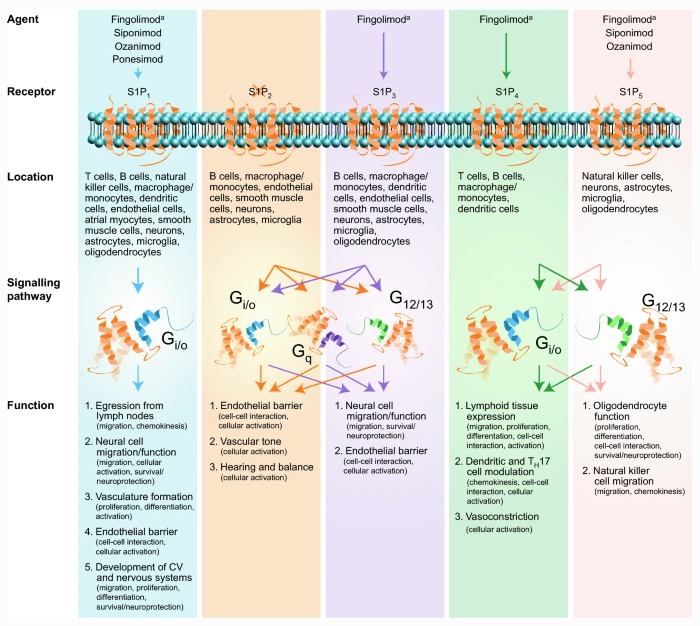
In my post on rebound disease activity in a person with secondary progressive MS switching from fingolimod to siponimod, someone asked whether there is any logic in switching DMTs within the class of S1P modulators. Two or three years ago I would have said no, but now I would say yes. There are well defined and clear differences between the two compounds that may explain their different effects as DMTs in people with more advanced or progressive MS (see figure and table below). 

The fact that fingolimod works on a broader spectrum of S1P receptors may explain why it has a greater effect on peripheral immune function, i.e. its action on S1P4 may explain why it disrupts antibody responses to new vaccines. S1P4 plays an important role in the functioning of germinal centres (GCs) in lymph nodes and other secondary lymphoid organs, i.e. so-called follicular T-helper cells use S1P4 for migration signals. If these cells can’t enter the GCs they can’t help B-cells make good antibody responses. I, therefore, predict that vaccine responses in response to the COVID-19 vaccines will be better preserved with siponimod, ozanimod and ponesimod because this new generation of S1P modulators has less or no activity on S1P4 receptors.  

Fingolimod needs to be phosphorylated to become active, in comparison siponimod is active already. This may explain why siponimod has greater activity on the S1P5 receptor within the central nervous system (CNS) and explains its greater apparent effects on cells within the central nervous system (CNS). It is clear that when you look at the results of the fingolimod in the PPMS trial there was very little evidence that fingolimod was having any effect on the end-organ, i.e. there was no impact on brain volume loss and no difference across any of the clinical endpoints in the PPMS trial. In comparison, siponimod has a clear CNS signal compared to placebo in subjects with SPMS. Compared to placebo, patients on siponimod have less whole brain, grey matter and thalamic volume loss, preservation of brain tissue integrity on MTR, an MRI marker of myelination, and these effects correlated with better preservation of cognition. On the downside, siponimod was associated with a small but significant risk of seizures, which seems to be more common than with fingolimod in adults with MS.  

I have interpreted these results as showing fingolimod as being a more powerful peripheral immunosuppressive therapy but has fewer direct CNS effects. In comparison, siponimod is likely to be less immunosuppressive, but have more direct CNS effects. So based on these differences I think there is a rationale for switching someone on fingolimod to siponimod who has more advanced MS or has transitioned to SPMS. The downside of this switch is that in the NHS you will have to label someone as having SPMS to be able to prescribe siponimod. Using our current criteria SPMS is a one-way street, i.e. once you are labelled as having SPMS you can’t be undiagnosed and converted back to RRMS. As there are no other DMTs currently licensed for SPMS you are therefore theoretically stuck with siponimod. This is why I refer to siponimod as the cul de sac DMT. 

The other issue is that to be eligible for siponimod you have to have active SPMS, i.e. relapses or MRI activity (new or enlarging lesions) in the last 2 years. Most people who develop SPMS on fingolimod have inactive SPMS, which means they are not eligible for siponimod. To become eligible under NHS England guidelines you would have to stop fingolimod and hope you develop rebound disease activity that will then allow you to be eligible for siponimod. I have previously stated that I think this is unethical based on our current biological understanding of MS. In any case, once you label someone as having SPMS on fingolimod you are meant to stop their fingolimod in the NHS; the latter is one of the NHS England’s stopping criteria.

So based on the above if you have transitioned to SPMS on fingolimod would you (1) want to switch to siponimod and (2) would you be prepared to stop fingolimod so that your SPMS became active, i.e. developed rebound disease activity? 

FingolimodSiponimod
MOA: Targets S1P1, S1P3, S1P4 & S1P5MOA: Targets S1P1 & S1P5
No baseline pharmacogenomicsBaseline pharmacogenomics (CYP2C9 genotyping)CYP2C9 Genotypes *1/*1, *1/*2, or *2/*2 = 2 mg/dayCYP2C9 Genotypes *1/*3 or *2/*3  = 1 mg /dayModerate CYP2C9 and strong CYP3A4 inducers are not recommended (e.g. rifampin, carbamazepine) 
First dose monitoring for all patientsFirst dose monitoring in patients with certain pre-existing cardiac conditions
Half life of 6-9 daysHalf life of approximately 30 hours
Lymphocyte counts progressively return to normal range within 1-2 months of stopping therapy in most patientsLymphocyte counts return to the normal range within 10 days of stopping therapy in the vast majority (90%) of patients
Prodrug – needs to phosphorylatedActive compound no need for activation

Conflicts of Interest

Preventive Neurology

Twitter

LinkedIn

Medium

General Disclaimer: Please note that the opinions expressed here are those of Professor Giovannoni and do not necessarily reflect the positions of the Barts and The London School of Medicine and Dentistry nor Barts Health NHS Trust.

What’s in a name?

You will have noticed that a lot of discussion on this blog has recently been devoted to the topic of secondary progression or smouldering MS or whatever else you want to call it. At the moment there is no standard terminology for describing the scenario of someone with MS who is NEDA-2 (no relapses and no activity on MRI) who is getting worse. The getting worse could be overt, i.e. worsening EDSS, or a more subtle deterioration, which can only be detected using more sensitive outcome measures, or asymptomatic.

Can you let us know which term you prefer?

  1. Non-relapsing SPMS
  2. Inactive SPMS
  3. Hidden SPMS
  4. Hidden progression
  5. Silent progression
  6. Progression independent of relapses (PIRA)
  7. Smouldering MS
  8. Worsening MS
  9. Festering MS

I personally don’t like the use of secondary progression in the term. This excludes MSers with a primary progressive course who have the same pathology and entrenches the dogma that relapse-onset MS and PPMS are different and separate diseases.

Hidden is another term that I don’t like; what is hidden for some MSers may not be hidden for other MSers. For example, cognitive impairment only becomes a problem when you stress your brain. Some MSers may be in a life stage when cognitive stressors are rare and others may stress or test their cognitive abilities on a daily basis.

The term PIRA seems to have the lead at the moment and is being used more and more in abstracts and meetings. Worsening MS is a catch-all phrase that by definition can occur in the presence or absence of relapses and hence according to the Lublin classification you can have active-worsening and inactive-worsening MS. Please note that according to Lublin the worsening has to be overt, i.e. captured using an objective outcome measure.

I like smouldering MS because it creates a visual analogy of what is happening to the brain and spinal cord of MSers. In other words, the flames or relapses and focal MRI activity have been quelled, but the embers continue to burn. It also implies that the embers can fire-up and reignite the flames at any stage. I have a potential conflict in that the term ‘smouldering MS’ may have been used first on this blog and hence we have a vested interest in this term being selected. 

What do you think?

CoI: multiple