Fingolimod vs. Siponimod

Barts-MS rose-tinted-odometer: ★★ (mid-week sepia = #704214)

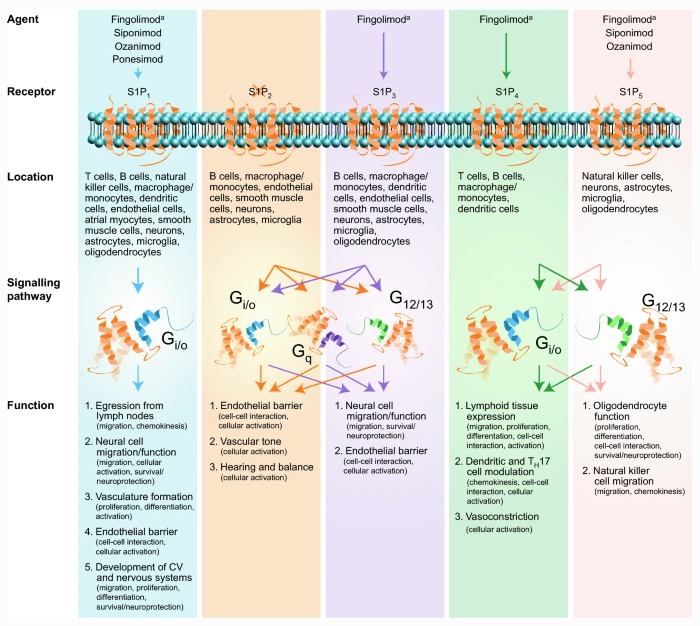
In my post on rebound disease activity in a person with secondary progressive MS switching from fingolimod to siponimod, someone asked whether there is any logic in switching DMTs within the class of S1P modulators. Two or three years ago I would have said no, but now I would say yes. There are well defined and clear differences between the two compounds that may explain their different effects as DMTs in people with more advanced or progressive MS (see figure and table below). 

The fact that fingolimod works on a broader spectrum of S1P receptors may explain why it has a greater effect on peripheral immune function, i.e. its action on S1P4 may explain why it disrupts antibody responses to new vaccines. S1P4 plays an important role in the functioning of germinal centres (GCs) in lymph nodes and other secondary lymphoid organs, i.e. so-called follicular T-helper cells use S1P4 for migration signals. If these cells can’t enter the GCs they can’t help B-cells make good antibody responses. I, therefore, predict that vaccine responses in response to the COVID-19 vaccines will be better preserved with siponimod, ozanimod and ponesimod because this new generation of S1P modulators has less or no activity on S1P4 receptors.  

Fingolimod needs to be phosphorylated to become active, in comparison siponimod is active already. This may explain why siponimod has greater activity on the S1P5 receptor within the central nervous system (CNS) and explains its greater apparent effects on cells within the central nervous system (CNS). It is clear that when you look at the results of the fingolimod in the PPMS trial there was very little evidence that fingolimod was having any effect on the end-organ, i.e. there was no impact on brain volume loss and no difference across any of the clinical endpoints in the PPMS trial. In comparison, siponimod has a clear CNS signal compared to placebo in subjects with SPMS. Compared to placebo, patients on siponimod have less whole brain, grey matter and thalamic volume loss, preservation of brain tissue integrity on MTR, an MRI marker of myelination, and these effects correlated with better preservation of cognition. On the downside, siponimod was associated with a small but significant risk of seizures, which seems to be more common than with fingolimod in adults with MS.  

I have interpreted these results as showing fingolimod as being a more powerful peripheral immunosuppressive therapy but has fewer direct CNS effects. In comparison, siponimod is likely to be less immunosuppressive, but have more direct CNS effects. So based on these differences I think there is a rationale for switching someone on fingolimod to siponimod who has more advanced MS or has transitioned to SPMS. The downside of this switch is that in the NHS you will have to label someone as having SPMS to be able to prescribe siponimod. Using our current criteria SPMS is a one-way street, i.e. once you are labelled as having SPMS you can’t be undiagnosed and converted back to RRMS. As there are no other DMTs currently licensed for SPMS you are therefore theoretically stuck with siponimod. This is why I refer to siponimod as the cul de sac DMT. 

The other issue is that to be eligible for siponimod you have to have active SPMS, i.e. relapses or MRI activity (new or enlarging lesions) in the last 2 years. Most people who develop SPMS on fingolimod have inactive SPMS, which means they are not eligible for siponimod. To become eligible under NHS England guidelines you would have to stop fingolimod and hope you develop rebound disease activity that will then allow you to be eligible for siponimod. I have previously stated that I think this is unethical based on our current biological understanding of MS. In any case, once you label someone as having SPMS on fingolimod you are meant to stop their fingolimod in the NHS; the latter is one of the NHS England’s stopping criteria.

So based on the above if you have transitioned to SPMS on fingolimod would you (1) want to switch to siponimod and (2) would you be prepared to stop fingolimod so that your SPMS became active, i.e. developed rebound disease activity? 

FingolimodSiponimod
MOA: Targets S1P1, S1P3, S1P4 & S1P5MOA: Targets S1P1 & S1P5
No baseline pharmacogenomicsBaseline pharmacogenomics (CYP2C9 genotyping)CYP2C9 Genotypes *1/*1, *1/*2, or *2/*2 = 2 mg/dayCYP2C9 Genotypes *1/*3 or *2/*3  = 1 mg /dayModerate CYP2C9 and strong CYP3A4 inducers are not recommended (e.g. rifampin, carbamazepine) 
First dose monitoring for all patientsFirst dose monitoring in patients with certain pre-existing cardiac conditions
Half life of 6-9 daysHalf life of approximately 30 hours
Lymphocyte counts progressively return to normal range within 1-2 months of stopping therapy in most patientsLymphocyte counts return to the normal range within 10 days of stopping therapy in the vast majority (90%) of patients
Prodrug – needs to phosphorylatedActive compound no need for activation

Conflicts of Interest

Preventive Neurology

Twitter

LinkedIn

Medium

General Disclaimer: Please note that the opinions expressed here are those of Professor Giovannoni and do not necessarily reflect the positions of the Barts and The London School of Medicine and Dentistry nor Barts Health NHS Trust.

Be careful when switching from Fingolimod to Siponimod

Barts-MS rose-tinted-odometer: zero-★s (purple Sunday)

The following case suggests a horizontal switch from fingolimod to siponimod may not be the wisest thing to do. This patient developed severe fingolimod rebound despite switching to siponimod without a washout. As you know fingolimod works on 4 out of 5 of S1P receptors (S1P1, 3, 4, and 5). In comparison, siponimod works on S1P1 and S1P5 only. Is this telling us that some of the modes of action of the S1P modulators are via S1P3 and S1P4? I suspect Yes. S1P4 may be important for antigen presentation and germinal centre (GC) function in lymph nodes and other secondary lymphoid organs, which explains why COVID-19 vaccine responses are so flat in pwMS on fingolimod. If this is correct then we may see better vaccine response in patients on the other S1P modulators that don’t impact GC biology to the same extent.  

I predict that there will be many more patients like this. The important thing is to ask why and to explore exactly what the differences are between fingolimod and siponimod on immune function in MS. Who knows what it is telling us about the cause and immunology of MS. 

Senzaki et al. Disease reactivation in a patient with secondary progressive multiple sclerosis after switching treatment from fingolimod to siponimod. eNeurologicalSci. 2021 May 15;23:100346. doi: 10.1016/j.ensci.2021.100346.

Excerpt: …… A 42-year-old woman with RRMS was started on fingolimod due to high disease activity; three relapses in the previous year and the presence of gadolinium-enhancing brain lesions before fingolimod. During the first two years after initiation of fingolimod, she experienced several relapses with incomplete recovery and progressive increase in brain magnetic resonance imaging (MRI) lesion load, and her EDSS deteriorated from 3.5 to 5.5. In the next five years, she was relapse-free without MRI activity; however, her disability gradually worsened to EDSS score of 7.0 and she was diagnosed with SPMS. Fingolimod was switched to siponimod without a wash-out period. Peripheral lymphocyte count at initiation of siponimod (day 1) was 376/μL, and 433/μL at day 7. She developed double vision at day 11.  Neurological examination revealed no new additional findings except for right internuclear ophthalmoplegia. Brain MRI showed multiple hyperintense infra- and supra-tentorial lesions on fluid-attenuated inversion-recovery images, some of which were enhanced with gadolinium (Fig. 1).

Conflicts of Interest

Preventive Neurology

Twitter

LinkedIn

Medium

General Disclaimer: Please note that the opinions expressed here are those of Professor Giovannoni and do not necessarily reflect the positions of the Barts and The London School of Medicine and Dentistry nor Barts Health NHS Trust.

#MSCOVID19: Cladribine 3 vs. Ocrelizumab 1 vs. Fingolimod 0

Barts-MS rose-tinted-odometer: ★★★★★

Finally, the early Israeli COVID-19 vaccine seroconversion rates are out as a peer-reviewed publication. This data is not new but comes with being vetted by the scientific community and hence can be quoted and discussed at scientific meetings.

Protective humoral immunity was 97.9% in healthy subjects, 100% untreated pwMS, 100% in cladribine-treated pwMS, 22.7% in ocrelizumab-treated pwMS and 3.8% in fingolimod-treated pwMS. As I have said before this is only half the story and we need to know what happens on the T-cell side. 

IgG antibodies to the virus implies a good T-cell response as well; this is because to class switching to IgG happens in the germinal centres with T-cell help. The corollary does not necessarily hold, i.e. if you don’t make IgG antibodies you can’t assume that vaccine-induced T-cell responses are absent. This is why I predict, based on the fact that both ocrelizumab and fingolimod treated pwMS recover from COVID-19 implying their T-cells are working and helping to clear the virus, that both ocrelizumab- and fingolimod-treated patients are likely to have some T-cell immunity to SARS-CoV-2 spike protein post-vaccination. 

Please note this is a prediction and we will need to wait for more detailed immunological studies. Even if patients on these agents have some T-cell responses the question will remain whether this blunted vaccine-induced immunity against SARS-CoV-2 will be sufficient to protect these patients against getting COVID-19 or repeated episodes of COVID-19? This question will take much longer to answer, but I suspect this limited immunity won’t be sufficient because vaccine immunity is likely to wane with time and new immune escape variants of SARS-CoV2 will emerge. Already public health officials are planning for rounds of booster vaccines to cover new variants. What this means is that vaccine-readiness will become uppermost in the minds of pwMS and HCPs when deciding on which DMTs to choose for particular patients.

The good news is that if you have MS and have been treated with cladribine there is no blunting of vaccine-induced responses. This is not surprising and was predicted based on the immunology of cladribine and justifies my previous blog post taking the NMSS to task on their ill thought out initial COVID-19 vaccine guidelines. Fortunately, these have been updated and pwMS on cladribine can be confident to go ahead with getting vaccinated ASAP. 

Figures from Ther Adv Neurol Disord 2021, Vol. 14: 1–8.

I would extrapolate the ocrelizumab vaccine data to the other anti-CD20 therapies, i.e. rituximab, ofatumumab and ublituximab, but not necessarily the fingolimod data to the other S1P modulators. There is evidence that fingolimod not only traps lymphocytes in lymph nodes but also depletes lymphocytes. In comparison to fingolimod, ozanimod and ponesimod deplete lymphocytes less intensely and at least for ponesimod, the recovery of lymphocytes is very rapid implying lymphocytes are not depleted on this drug.  So I would not be surprised if ponesimod, and possibly ozanimod, have less of an effect on vaccine responses than fingolimod. As for siponimod, I predict it will be closer to fingolimod in terms of its effect on neoantigen (new antigen) vaccine responses such as the COVID-19 vaccines. 

Does this data change anything about my current practice? No, not really, it is entirely in keeping with what I predicted. My advice is still #GetVaccinatedASAP. This data however may impact what treatment patients with MS decide to start off on; if vaccine responses are important to you, say for travel and/or work reasons, you may want to avoid S1P modulators and anti-CD20 therapies.

Please note I have put on my rose-tinted glasses; the sun is shining outside and spring is wonderful 😉

Achiron et al. Humoral immune response to COVID-19 mRNA vaccine in patients with multiple sclerosis treated with high-efficacy disease-modifying therapies. Ther Adv Neurol Disord 2021, Vol. 14: 1–8.

Background and Aims: The National Multiple Sclerosis Society and other expert organizations recommended that all patients with multiple sclerosis (MS) should be vaccinated against COVID-19. However, the effect of disease-modifying therapies (DMTs) on the efficacy to mount an appropriate immune response is unknown. We aimed to characterize humoral immunity in mRNA-COVID-19 MS vaccinees treated with high-efficacy DMTs.

Methods: We measured SARS-CoV-2 IgG response using anti-spike protein-based serology (EUROIMMUN) in 125 MS patients vaccinated with BNT162b2-COVID-19 vaccine 1 month after the second dose. Patients were either untreated or under treatment with fingolimod, cladribine, or ocrelizumab. A group of healthy subjects similarly vaccinated served as control. The percent of subjects that developed protective antibodies, the titer, and the time from the last dosing were evaluated.

Results: Protective humoral immunity of 97.9%, 100%, 100%, 22.7%, and 3.8%, was observed in COVID-19 vaccinated healthy subjects (N = 47), untreated MS patients (N = 32), and MS patients treated with cladribine (N = 23), ocrelizumab (N = 44), and fingolimod (N = 26), respectively. SARS-CoV-2 IgG antibody titer was high in healthy subjects, untreated MS patients, and MS patients under cladribine treatment, within 29.5–55 days after the second vaccine dose. Only 22.7% of patients treated with ocrelizumab developed humoral IgG response irrespective to normal absolute lymphocyte count. Most fingolimod-treated MS patients had very low lymphocyte count and failed to develop SARS-COV-2 antibodies. Age, disease duration, and time from the last dosing did not affect humoral response to COVID-19 vaccination.

Conclusions: Cladribine treatment does not impair humoral response to COVID-19 vaccination. We recommend postponing ocrelizumab treatment in MS patients willing to be vaccinated as a protective humoral response can be expected only in some. We do not recommend vaccinating MS patients treated with fingolimod as a protective humoral response is not expected.

Conflicts of Interest

Preventive Neurology

Twitter

LinkedIn

Medium

General Disclaimer: Please note that the opinions expressed here are those of Professor Giovannoni and do not necessarily reflect the positions of the Barts and The London School of Medicine and Dentistry nor Barts Health NHS Trust.

Why does fingolimod affect antibody responses?

Barts-MS rose-tinted-odometer:  ★

The Twittersphere is abuzz with the preliminary seroconversion rates in Israelis patients with MS on various DMTs in response to the Pfizer-BionTech COVID-19 vaccine (see below). As expected the antibody seroconversion rates in response to anti-CD20 therapies and S1P modulators are blunted and in most cases inhibited. The backstory or biology around anti-CD20 therapy is well-rehearsed; anti-CD20 therapy depletes B-cells and annihilates germinal centres in lymph nodes and the spleen.

The question I have just been asked is why does fingolimod block antibody responses? To answer this we need to go back to the basics of immunology. 

Fingolimod and other S1P modulators work by internalising the S1P receptor making lymphocytes unresponsive to the S1P signalling or chemotaxis gradient in secondary lymph organs such as lymph nodes. In lay language, this causes lymphocytes to park-up in a long-term car park with a wheel lock-on. Even if you wanted to drive your car out of the car park by starting it up you wouldn’t be able to move it without removing the wheel-lock (fingolimod). By blocking lymphocyte mobility helper T-cells can’t migrate to the so-called germinal centres in the lymph nodes and spleen to help B-cells switch from IgM to IgG antibody production and to then help the B-cells to affinity mature their antibodies, i.e. to make good quality antibodies. Normally these affinity matured B-cells would leave the germinal centre to become memory B-cells or plasmablasts. The plasmablasts then mature to become plasma cells and produce high-quality antibodies, which in the case of anti-spike protein protect you from getting COVID-19 in particular severe COVID-19. Fingolimod and other S1P modulators prevent this normal immunology from happening hence the low or absent anti-COVID-19 antibody response after COVID-19 vaccination.

I like to think of the germinal centres as being the immune system’s university; this is where the immune system sends its primed T-cells to help educate B-cells. After a brutal natural selection process in the germinal centres, a few B-cells survive and graduate with a PhD, i.e. a highly specialised degree or class-switched high-affinity IgG antibodies. This then allows the B-cells to become memory B cells and go into semi-retirement or to set-up their own production company as plasma cells and to produce high-quality antibodies. Anti-CD20 therapies work by blowing up the B-cell university and S1P modulators stop the teachers (T-cells) from educating their students (B-cells). Having no university or no teacher-student interactions have the same effect and result in no educated B-cells and hence no IgG antibody responses.

Please note the above information does not change my personal advice regarding vaccination, whether you are on an anti-CD20 therapy, fingolimod or another S1P modulator (siponimod, ozanimod, ponesimod) #GetVaccinated ASAP; some immunity is better than no immunity. Please note having no anti-SARS-CoV-2 antibodies doesn’t necessarily mean you have no immunity. These antibody studies don’t tell us anything about T-cell responses, which are likely to be as important as antibodies in providing protecttive immunity against SARS-CoV-2.

Han et al. FTY720 suppresses humoral immunity by inhibiting germinal center reaction. Blood. 2004 Dec 15;104(13):4129-33. doi: 10.1182/blood-2004-06-2075. Epub 2004 Aug 19.

FTY720 is a novel immunosuppressant that is highly effective in inhibiting rejection of allografts and autoimmunity in various animal models. It has been shown that the sphingosine 1 phosphate (S1P) receptors are the direct molecular targets of FTY720. However, the mechanisms responsible for inhibiting specific immune responses by FTY720 are not well resolved. In particular, there is no available information on whether or how this compound affects humoral immunity. We have investigated the effect of FTY720 treatment on B-cell response during the immune response to a well-defined T-dependent antigen. Our data demonstrated that germinal center reaction was significantly reduced in peripheral lymphoid tissues of mice treated with FTY720. In addition, FTY720 treatment inhibited the production of high-affinity, class-switched antibodies, but not the production of low-affinity, immunoglobulin M (IgM) antibody. Consistently, FTY720 did not have a significant effect on antibody response to a T-independent antigen. Our results may have important implications in application of FTY720 in immune regulation.

Also see the post by MD from a few days ago. Fingolimod also stops B cells moving within the follciles and and stops them contacting areas where they the B cells are likely to be stimulated.

CoI: multiple

Twitter: @gavinGiovannoni                                              Medium: @gavin_24211

Are you a super-responder?

Barts-MS rose-tinted-odometer: ★★

For every DMT there are patients who respond and there are those who don’t respond. Trying to predict who will be a responder and non-responder is not possible upfront. This is why we talk in averages, i.e. what happens to populations of patients and extrapolate backwards to the individual. If only we have individualised or personalised prediction tools. 

The study below shows a cohort of glatiramer acetate super-responders who are doing as well a group of patients on fingolimod when it comes to the end-organ, i.e. losing brain volume loss. Could you imagine a world when we didn’t have to gamble with time and we could select the treatment that will do the job we want it to in terms of protecting your brain for when you get older? 

In my talk at the MSVirtual2020 meeting this year I try and communicate these concepts using an actuarial approach. Is it understandable? As it is your brain what have you done? 

<iframe width="560" height="315" src="https://www.youtube.com/embed/owhRLn3XwCs" frameborder="0" allow="accelerometer; autoplay; clipboard-write; encrypted-media; gyroscope; picture-in-picture" allowfullscreen></iframe>

Honce et al. Brain Atrophy Rates for Stable Multiple Sclerosis Patients on Long-Term Fingolimod versus Glatiramer Acetate. Frontiers in Neurology 2020 Sep 23;11:1045. 

Background: Clinically stable multiple sclerosis (MS) patients on long-term therapy often have negligible acute inflammation on MRI. Brain atrophy may provide insight into subclinical disease progression in such populations. Objective: This study aims to compare brain atrophy for age- and gender-matched MS patients treated for >2 years with fingolimod (FTY) or glatiramer acetate (GA), examining brain volume, cognition, and patient-reported outcomes (PROs). 

Methods: Stable relapsing-MS patients, age 18-60, on FTY or GA for >2 years were followed up for 2 years. MRI brain and lesion volumes, cognitive measures, and PROs were collected at baseline and annually. 

Results: Forty-four FTY and forty-three GA patients completed baseline and year 2 visits. No differences in age, gender, or education were observed. Median EDSS was 2.0GA and 2.5FTY (p = 0.22). Treatment duration was longer for GA, 6.50GA vs. 3.73FTY years (p < 0.001). Baseline geometric mean T2LV were different, GA = 1,009.29 cm3 vs. FTY = 2,404.67 cm3 (p = 0.0071). Baseline brain volumes were similar, GA = 1,508 cm3 vs. FTY = 1,489 cm3 (p = 0.2381). Annualized atrophy rates, adjusted for baseline and at mean baseline value, were GA = -0.2775% vs. FTY = -0.2967% (p = 0.7979). No differences in cognitive measures or PROs were observed. 

Conclusions: Stable MS patients on long-term treatment with FTY and GA have similar brain volume loss rates. Differences in baseline disease severity may suggest patients with more aggressive disease treated with FTY may achieve similar brain volume loss rates as patients with milder baseline disease on GA.

CoI: multiple

Twitter: @gavinGiovannoni           Medium: @gavin_24211

#COVIDMS Will COVID-19 mutate?

Human coronaviruses are predominantly associated with respiratory tract infections. This group of viruses includes viruses that cause severe acute respiratory syndrome (SARS), Middle East respiratory syndrome (MERS) and now the COVID-19 pandemic.

One human coronavirus HCoV-OC43 is generally associated with mild upper respiratory tract infections, although it has been shown to have neuroinvasive properties. Studies in mice have shown that HCoV-OC43 can infect neurons and cause encephalitis and has also been shown to cause persistent infections in human neural-cell lines.

There are case reports that have identified HCoV-OC43 RNA in the cerebrospinal fluid or brain of children with acute disseminated encephalomyelitis and acute encephalomyelitis (see below).

Why are these observations important? They are important because it suggests that coronaviruses are potentially neurotropic and hence can infect the central nervous system. As coronaviruses are RNA viruses they have low fidelity, i.e. their reproduction results in many variants or mutations. The so-called wild-type strain tends to mutate very rapidly and hence may produce neurotropic strains quite quickly. The latter is particularly important in the context of natalizumab and potentially fingolimod and other S1P modulators.

As natalizumab blocks immune surveillance of the CNS, a person on natalizumab who develops a COVID-19 encephalitis would be in danger of major complications of the infection and possibly succumbing to the infection. The latter is analogous to PML, which is also viral encephalitis, and herpes-simplex and varicella -zoster encephalitis and CMV retinitis that have all been described in people with MS on natalizumab. 

The reason why these complications happen on natalizumab is that natalizumab blocks trafficking of anti-viral lymphocytes into the central nervous system and so if a virus gets into the CNS it will cause damage unchecked by the immune system. The EMA’s summary of product characteristics (SmPC) for natalizumab is very clear on this issue:

Infections including other opportunistic infections 

TYSABRI increases the risk of developing encephalitis and meningitis caused by herpes simplex and varicella zoster viruses. Serious, life-threatening, and sometimes fatal cases have been reported in the postmarketing setting in multiple sclerosis patients receiving TYSABRI (see section 4.8). If herpes encephalitis or meningitis occurs, the medicinal product should be discontinued, and appropriate treatment for herpes encephalitis or meningitis should be administered. Acute retinal necrosis (ARN) is a rare fulminant viral infection of the retina caused by the family of herpes viruses (e.g. varicella zoster). ARN has been observed in patients being administered TYSABRI and can be potentially blinding. Patients presenting with eye symptoms such as decreased visual acuity, redness and painful eye should be referred for retinal screening for ARN. Following clinical diagnosis of ARN, discontinuation of TYSBABRI should be considered in these patients. Prescribers should be aware of the possibility that other opportunistic infections may occur during TYSABRI therapy and should include them in the differential diagnosis of infections that occur in TYSABRI-treated patients. If an opportunistic infection is suspected, dosing with TYSABRI is to be suspended until such infections can be excluded through further evaluations.

What to do about this knowledge in the current COVID-19 pandemic is very difficult. Professor Julian Gold, an HIV and infectious disease consultant in our group, is adamant that we need to relay this information to our patients and let them make the decision if they want to stop natalizumab or fingolimod. However, as stopping these agents can result in rebound MS disease activity it would be advisable for these patients to switch to an alternative or safer DMT, i.e. interferon-beta, glatiramer acetate or teriflunomide. Professor Gold favours interferon-beta or teriflunomide as they have been shown to have antiviral effects. 

As there is no consensus on this I am doing a survey via the MS Academy to find out what the wider MS community of HCPs feels about this and other issues. Just maybe the wisdom of the crowd will be better than an individual or small group opinion. 

In the event of widespread COVID-19 epidemic, the logistics of derisking natalizumab and fingolimod is this way may not be feasible. A better way of managing this problem is reverse quarantine, i.e. at-risk patients stay on natalizumab or fingolimod and self-isolate at home to prevent themselves from becoming infected with the virus. 

The other issue I have already raised is when a vaccine emerges for COVID-19 pwMS may want to be on a DMTs that allows to receive the vaccine and mount a good response to the vaccine. Some DMTs blunt the vaccine responses.

I hope you appreciate that formulating advice when there is no evidence base is not easy. At the moment whilst the epidemic has yet to show its true extent in the UK I would advise MS patients on natalizumab or fingolimod to continue with treatment for now but to be extra-vigilant about hygiene measures. This advice may change or it may need to be personalised.

Finally, as soon as the ABN and MS Academy produce consensus guidelines I will post them on the blog. The problem about consensus is that it is often a compromise and in the absence of data may not be the best advice.

Yeh et al. Detection of Coronavirus in the Central Nervous System of a Child With Acute Disseminated Encephalomyelitis. Pediatrics January 2004, 113 (1) e73-e76.

We present a case in which human coronavirus was detected in the cerebrospinal fluid of a child presumed to have acute disseminated encephalomyelitis. In murine models, coronavirus has been found to cause a chronic demyelinating condition that resembles multiple sclerosis. Additionally, there is in vitro evidence of human coronavirus’s ability to infect neural cells. This case report provides additional support for the hypothesis that coronavirus may be an important etiologic factor in the pathogenesis of demyelinating disease in humans.

Morfopoulou et al. Human Coronavirus OC43 Associated with Fatal Encephalitis. N Engl J Med 2016; 375:497-498.

Excerpts:

….. Here we report the use of deep sequencing of a brain biopsy sample obtained from an 11-month-old boy with severe combined immunodeficiency who had symptoms of viral encephalitis with negative results on conventional diagnostic polymerase-chain-reaction (PCR) assay. 

….. The boy underwent unconditioned cord-blood transplantation, which resulted in T-cell engraftment. Nonetheless, his condition continued to deteriorate, and he died 1.5 months after receiving the transplant. RNA sequencing of a brain biopsy sample obtained 2 months after the onset of symptoms showed the presence of human coronavirus OC43 (HCoV-OC43), which was subsequently confirmed on real-time PCR (threshold cycle, 24) and brain immunohistochemical analysis. 

CoI: multiple

N.B. MOUSEDOC HERE So AS YOU KNOW THERE ARE ALREADY MUTATIONS IN THIS VIRUS THE ORIGINAL S VARIANTAND THE L VARIANT

What is advanced MS?

Barts-MS rose-tinted-odometer – zero stars

Someone recently asked what is advanced MS? I suspect they have been getting frustrated with our use of this adjective without a clearer understanding of what it really means. To find out if you have advanced MS you need to put yourself through a battery of stress tests to find-out much reserve you have left to deal with MS and life in the future.

What is advanced MS is a very important topic and we at Barts-MS have tried not to define it using the EDSS as it entrenches the physically-disabling, particularly lower-limb function, worldview of MS.  

Advanced MS is really when someone has lost reserve in a particular neuronal system and they are noticing worsening in that system that is impacting on their ability to function at a personal, social or occupational level and by inference is affecting their quality of life. 

Using this definition someone can have advanced MS with very little physical disability. As you are aware the initial impact of MS may be cognitive, which is probably the main driver of the high early unemployment rates we see in MS.

A software engineer with MS who depends on her cognitive skills for writing code, concentrating for prolonged periods of time and multitasking may find it very difficult-staying at the top of her game. She will notice much earlier her progressive cognitive loss based on her performance or lack of performance in her work. In comparison, a professional athlete may not necessarily notice early cognitive impairment but will be more susceptible to the effects of MS on their coordination and endurance, for example, the marathon runner with a dropped foot.

These examples are the two extremes, but they illustrate why we need stress tests of the nervous system to be able to ascertain how much reserve there is which will give us some idea how advanced MS is in a particular domain. One thing that is not done very well in MS clinics is cognition. Most MS centres don’t have the resources to monitor cognition properly. This needs to change (#ThinkCognition). 

In almost every MS clinic I do I see patients who complain of cognitive symptoms; increasing forgetfulness, difficulty multi-tasking, the inability to learn and use a new technology or cognitive fatigue.

One of my high functioning patients, who worked in a large City law firm, simply could not keep up and was forced to take early retirement because of her MS. She had been interferon-beta-1b for 12 years but had stopped treatment about 7 years ago when she had moved to London. Her MRI showed a highish lesion load and severe brain atrophy. She had had a few relapses on interferon-beta in the early years, but her neurologist decided to leave her on interferon-beta. Back then this was normal practice; we didn’t expect interferon-beta to render you relapse-free. Interferons were only meant to reduced attack rates by about a third and severe attacks, i.e. those requiring steroids and/or hospital admission, by about a half. The only alternative when this patient was having relapses on interferon-beta was glatiramer acetate; this was in the pre-natalizumab era.

Apart from her cognitive problems, this patient had mild unsteadiness of gait, but this had not affected her walking distance and she was still able to do yoga several times per week. To help with her unemployment insurance claim I requested a formal neuropsychological assessment and she was documented to have profound cognitive deficits across multiple domains. The conclusion based on these tests was that she would never be able to have meaningful employment again; at least not in the knowledge economy When I took a detailed history it was clear that she had had progressive cognitive impairment over at least 7-10 years. In other words, she had advanced (secondary progressive) MS manifesting as progressive dementia.

You must not underestimate the impact MS has on cognition. Cognitive problems can be there from the start; approximately a quarter of people with a radiologically isolated syndrome (RIS) or asymptomatic MS already have cognitive impairment. The proportion with cognitive impairment gets higher the longer you have the disease. What is driving cognitive impairment is almost certainly grey matter pathology, both in the cortex and deep grey matter, which is not detected with our current monitoring tools.

Until recently we the MS community used the Paced Auditory Serial Addition Test (PASAT) for monitoring cognition in clinical trials. The PASAT is a measure of cognitive function that assesses auditory information processing speed and flexibility, as well as calculation ability. The PASAT is presented using audiotape or disk to ensure standardization in the rate of stimulus presentation. Single digits are presented every 3 seconds and you have to add each new digit to the one immediately prior to it. Shorter inter-stimulus intervals, e.g., 2 seconds or less have also been used with the PASAT but tend to increase the difficulty of the task. The PASAT is very difficult and requires multitasking; it is a very good cognitive stress test. 

One of the reasons we dropped the PASAT test is because of its learning effect, when you do the PASAT test your scores improve because of so-called ‘learning’ or ‘practice’ effects. In reality this is a general phenomenon of most neurological stress tests; our nervous systems are wired for learning. 

In the FREEDOMS 1 and 2 pivotal phase 3 fingolimod trials, we showed that not being able to improve on the PASAT at baseline predicted a worse outcome. We hypothesised that pwMS who couldn’t learn, i.e. were unable to improve their PASAT scores at baseline, would do worse and this is exactly what we found and we noted it regardless of treatment allocation; i.e. whether you were on fingolimod or placebo. 

Not surprisingly, the poor learners were older, had a higher disability score at baseline, smaller brains and higher lesions volumes on MRI; i.e. they had reduced cognitive reserve or resilience. In other words, they had more advanced MS. The depressing point about this analysis was that even the poor learners on fingolimod did badly; it was if they were already primed to do badly and that starting a DMT had a limited impact on the outcome. In reality, their MS disease activity in the past had primed their brains to continue to deteriorate despite being on a DMT; previous damage or smouldering MS was now driving their disease worsening. This is why the treatment response on DMTs drop off with ageing and disease duration. Please note this applies to all DMTs, including HSCT. 

It is important to prevent the ravages of MS by treating as early and effectively as possible. Some pwMS are luckier than others; i.e. you may present very early in the course of your MS before too much end-organ damage has accrued. In others, the asymptomatic period of the disease may be longer, during which time you acquire a lot of end-organ damage. Regardless of what group you are in, you still need to seriously consider getting on top of your MS disease activity as soon as possible to prevent any further damage.  

It is clear from several data sources that on average pwMS do best on DMTs that have the greatest impact on inflammatory activity (new MRI lesions and relapses) and those that reduce brain volume loss. In reality, these are the high and very high efficacy DMTs. This is why flipping the pyramid and going for the most effective DMTs first-line is a very appealing treatment strategy; particularly the DMTs that ‘normalise’ brain volume loss.

This post illustrates why we should be monitoring cognition in routine MS clinical practice. Although this topic gets discussed and debated all the time most neurologists don’t agree with doing routine cognitive testing, because of the lack of evidence in terms of treatments that impact on cognition. This, however, will change as data emerges that DMTs have positive effects on cognitive function, even in advanced MS. For example, siponimod has been shown to delay cognitive worsening compared to placebo in people with SPMS. 

At Barts-MS we will continue to run our #ThinkCogniton campaign. By shifting the MS worldview from a physical one to a cognitive one we will hopefully get the MS community to manage MS more actively. 

Maria Pia Sormani et al. Learning Ability Correlates With Brain Atrophy and Disability Progression in RRMS. J Neurol Neurosurg Psychiatry, 90 (1), 38-43 Jan 2019.

Objective: To assess the prognostic value of practice effect on Paced Auditory Serial Addition Test (PASAT) in multiple sclerosis.

Methods: We compared screening (day -14) and baseline (day 0) PASAT scores of 1009 patients from the FTY720 Research Evaluating Effects of Daily Oral therapy in Multiple Sclerosis (FREEDOMS) trial. We grouped patients into high and low learners if their PASAT score change was above or below the median change in their screening PASAT quartile group. We used Wilcoxon test to compare baseline disease characteristics between high and low learners, and multiple regression models to assess the respective impact of learning ability, baseline normalised brain volume and treatment on brain volume loss and 6-month confirmed disability progression over 2 years.

Results: The mean PASAT score at screening was 45.38, increasing on average by 3.18 from day -14 to day 0. High learners were younger (p=0.003), had lower Expanded Disability Status Scale score (p=0.031), higher brain volume (p<0.001) and lower T2 lesion volume (p=0.009) at baseline. Learning status was not significantly associated with disability progression (HR=0.953, p=0.779), when adjusting for baseline normalised brain volume, screening PASAT score and treatment arm. However, the effect of fingolimod on disability progression was more pronounced in high learners (HR=0.396, p<0.001) than in low learners (HR=0.798, p=0.351; p for interaction=0.05). Brain volume loss at month 24 tended to be higher in low learners (0.17%, p=0.058), after adjusting for the same covariates.

Conclusions: Short-term practice effects on PASAT are related to brain volume, disease severity and age and have clinically meaningful prognostic implications. High learners benefited more from fingolimod treatment.

CoI: multiple

Japan epicentre of an Asian MS epidemic

I am about to return from a short MS meeting in Tokyo. This was my first exposure to Japan and Japanese culture. It is everything and more than I expected.

I am beginning to get a sense of what ikigai means. Ikigai translates ‘to a reason for being, encompassing joy, a sense of purpose and meaning and a feeling of well-being’. Ikigai derives from iki, meaning life and kai, meaning the realisation of hopes and expectations.

I first learnt about ikigai from the ‘Blue Zones’, a book by Dan Buettner, on the secrets of the world’s ‘happiest places’, where people are super-agers. One of the blue zones is Okinawa, a subtropical Japanese island to the South of Japan. Some of the philosophy underpinning happiness and super-ageing is cultural and is specific to the Japanese culture.

The lessons of the blue zones are applicable to our Brain Health initiative and I would urge you to read the book. Who knows it may change the way you want to live your life regardless of whether or not you have MS.

It is clear that MS is a problem in Japan and the incidence and prevalence is rising. Why? Japan is now one of the epicentres of the global MS epidemic; i.e. an area of the world where MS has gone from a low to a medium incidence area, similar to Iran, and will quite soon become a high incidence area. The clue to this is the rapidly increasing sex ratio of females to males that is now over 3:1.

As an MS community, we need to study these epicentres to see if we can pin down the cause of MS and put in place robust prevention trials. Japan has rapidly westernised and the Japanese neurologists I spoke to think this is the reason why the incidence of MS is increasing in Japan. Not sure I buy this at face value. What is it about the Western lifestyle that is causing MS? Could it be childhood obesity? Processed carbohydrate/sugar consumption? Smoking? Change in the epidemiology of EBV infection; a different strain, later infection, more infectious mononucleosis? Less sunshine and lower vitamin D levels?

It is interesting that Japanese neurologists think MS is more benign in Japan than elsewhere. I am not sure why they think this. All the evidence I saw this weekend points to Japanese MS being identical to Western European MS. Unfortunately for Japanese MSers, they have access to fewer DMTs and there are only two highly effective DMTs licensed in Japan, i.e. fingolimod and natalizumab. There is also a much higher JCV seroprevalence rate in Japan of close to 80% with a higher proportion of people with a high anti-JCV index. This makes the risk of PML potentially much higher in Japan. For example, there have been 4 cases of non-carryover PML on fingolimod, which equates to a PML rate of about 1 in 1,000 to 1,500 per fingolimod-treated MSer. This is an order of magnitude higher than the non-carryover PML rate on fingolimod outside of Japan and clearly needs further study.

Another factor is the reluctance of Japanese neurologists to use off-label treatments, for example, subcutaneous cladribine and rituximab. The reasons for this are multiple but mainly relate to lack of reimbursement and cultural factors. It was also clear that the Japanese neurologist, similar to British neurologists, are quite conservative and prefer a step-care approach. The Japanese are particularly concerned that because of their ancestry they may respond differently to DMTs, which have been tried and tested in other populations. In other words, they need data on the safety and efficacy of specific DMTs in their own Japanese MS population. To get a drug licensed in Japan Pharma has to trials in Japan.

As a result of the JCV problem extended interval dosing of natalizumab, also referred to as EID, and PML surveillance (3-monthly MRI monitoring) is very important for natalizumab-treated Japanese MSers. In fact, Japan is the one country that the derisking of PML for natalizumab is critical. Until other high-efficacy DMT arrive the Japanese are going to have to make do with fingolimod and natalizumab. In comparison, we are spoilt for choice in the UK and other high-income countries; we have forgotten what it was like to manage MS before the avalanche of new DMTs.

I have uploaded my slides from Japan on my slideshare site; you are welcome to download them and repurpose the slides for your own uses. I presented our #AttackMS study as a way to illustrate how important time matters in MS. I am not sure the Japanese neurologists agreed with such an active approach to treating MS. Do you?

Houzen et al.  Consistent increase in the prevalence and female ratio of multiple sclerosis over 15 years in northern Japan. Eur J Neurol. 2018 Feb;25(2):334-339.

BACKGROUND AND PURPOSE: The prevalence of multiple sclerosis (MS) is considered to be lower in East Asia than in Western countries. An increasing trend has been reported globally for the prevalence of MS. We investigated the changes in the prevalence and clinical characteristics of MS in the Tokachi province of Hokkaido, northern Japan from 2001 to 2016.

METHODS: Prevalence was determined on 31 March 2016. Data-processing sheets were collected from all MS-related institutions in Tokachi province. We applied Poser’s diagnostic criteria for MS as used in our previous three studies. Cases of neuromyelitis optica spectrum disorders were excluded.

RESULTS: In 2016, the crude MS prevalence was 18.6/100 000 (95% confidence interval, 14.3-23.8) in northern Japan. Over the last 15 years, the prevalence of MS in the same area was 8.1, 12.6 and 16.2 in 2001, 2006 and 2011, respectively. The female:male ratio was 3.57, which increased from 2.63 in 2001. The ratios of primary progressive, relapsing-remitting and secondary progressive MS types were 2%, 84% and 14%, respectively.

CONCLUSION: Our results demonstrated a consistent increase in MS prevalence among the northern Japanese population, particularly in females, and relatively lower rates of progressive MS in northern Japan than in Western countries.

CoI: multiple

Warts and all

I have previously made the case that warts, both cutaneous and genital, are a relative contraindication to alemtuzumab therapy. I had one patient who has a torrid time with cutaneous warts after receiving alemtuzumab treatment. Fortunately, her immune system rejected them when it reconstituted and she is now fine.

At least with alemtuzumab and other IRTs (immune reconstitution therapies) you can rely on the immune system reconstituting; not so with continuous immunosuppressants.

I saw someone with MS yesterday who is on fingolimod with cutaneous warts, which are spreading, getting worse and causing a lot of discomfort. They were bleeding and were obviously causing her some distress. The bottom line is that the warts are unlikely to clear whilst she remains on fingolimod. Fingolimod is a drug that was repurposed from the solid-organ transplant field and is a chronic high-level immunosuppressant targeting both T and B cell responses of the immune system.

Warts on fingolimod is not a new problem; it is well described. In the case series below warts only responded to treatment and cleared when fingolimod was stopped. The problem is what to do about MS and MS rebound when you stop the fingolimod? In my opinion, the only solution is to go onto a DMT that is not a systemic immunosuppressive; these include interferon-beta, glatiramer acetate, teriflunomide and natalizumab. Another option is ocrelizumab as it selectively targets B-cells and leaves the T-cell compartment relatively intact, i.e. for the CD8+ cytotoxic T-cells to fight the viral infection that is causing warts.

Cutaneous warts (image from eMedicineHealth)

The main problem we have in the NHS is the NHS England’s handcuffs in terms of eligibility for specific DMTs. This particular patient has previously failed the injectables so she is not going back onto those, she would not eligible for natalizumab as she does not have rapidly-evolving severe MS, which leaves only teriflunomide and ocrelizumab as viable options. The advantage of teriflunomide is that it is an oral agent, it has known antiviral effects and has a reversible mode of action. In comparison, ocrelizumab is a more effective DMT on average than teriflunomide, but as ocrelizumab is a depleting monoclonal antibody its action is irreversible. Ocrelizumab is also immunosuppressive and there is a definite herpes zoster signal with ocrelizumab, compared to interferon-beta and placebo. Ocrelizumab may, therefore, affect T-cell antiviral responses to HPV to some degree. Therefore based on a scientific rationale I would think the best agent for this patient is teriflunomide and if she is not keen on a de-escalation strategy, i.e. dropping down to a less effective agent, then she should switch to ocrelizumab. Do you agree?

She should also see a virologist to get the human papillomavirus causing warts genotyped. If this genotype is one that is covered by the polyvalent HPV vaccine (Gardasil-9) she may be able to receive this vaccine to boost her immunity to the virus once she is off fingolimod and on teriflunomide.

Triplett et al. Warts and all: Fingolimod and unusual HPV-associated lesions. Mult Scler. 2018 Nov 14:1352458518807088.

BACKGROUND: Fingolimod is used to reduce relapse rates in relapsing-remitting multiple sclerosis (MS). It is a sphingosine 1-phosphate (S1P) analogue having antagonistic effects on S1P receptors. Its immunosuppressive effect is due to reduced circulating lymphocyte numbers, and it may also be associated with impaired intrinsic cancer surveillance. Fingolimod side effects include increased rates and severity of viral infections particularly varicella zoster.

METHODS: We present five cases of chronic and treatment-refractory warts associated with fingolimod therapy.

RESULTS: Each of the five cases presenting with chronic warts while receiving fingolimod therapy had prolonged periods of lymphopenia and improvements were seen following dose reduction or cessation of fingolimod.

CONCLUSION: Cutaneous warts are associated with human papillomavirus (HPV) infection, suggesting an increased risk of other HPV-driven conditions such as cervical cancer following fingolimod administration. HPV viruses are responsible for approximately 90% of cervical cancers as well as a significant portion of anogenital cancers and have a high prevalence in sexually active adults. Given the reduced immune response to viral infections and potential impaired cancer surveillance in those receiving fingolimod, HPV vaccination and frequent assessment for the development of HPV-associated malignancies are recommended.

CoI: multiple

Beyond NEDA

Prof G are we being lulled into a false sense of security by being told that we have no evident disease activity (NEDA)?

A patient of mine, who I have been looking after now for over 11 years, asked me in clinic a few weeks ago why despite being NEDA for 6 years, on a highly effective maintenance DMT (fingolimod), has she gone from being able to run 5-10 km to needing a stick and barely managing to walk from the Whitechapel Underground Station to my clinic (~200m), without having to stop and rest?

What this patient doesn’t know, despite no new visible T2 lesions, is that she has developed obvious, to the naked eye, progressive brain atrophy.  This particular patient prompted me to write a few blog posts to try and explain what is happening to her brain. Before reading the remainder of this post you may want to read the following posts:

An important question in relation to this patient is why do some DMTs have such a profound impact on end-organ damage markers, in particular, brain volume loss and others do not? Not all DMTs are made equal when it comes to preventing, or slowing down, brain volume loss.

At the top of the league table are alemtuzumab and HSCT (~0.2-0.25% loss per annum). Both these treatments are NIRTs (non-selective immune reconstitution therapies). Natalizumab is next with an annual brain volume loss in region of 0.25-0.30% per annum. Ocrelizumab (anti-CD20) comes fourth with a rate of brain volume loss of ~0.30-0.35% per annum. Fingolimod 5th at ~0.4% per annum. Cladribine has a rate of loss of brain volume of ~0.55% per annum with the other runs after that.

For me, the disappointment are the anti-B cell therapies, ocrelizumab and cladribine. Despite these DMTs being very effective at switching off new focal inflammatory lesions (relapses and new T2 and Gd-enhancing lesions) their impact on end-organ damage is only moderate. These observations have convinced me more than ever that focal inflammation is not MS, but simply the immune system’s response to what is causing MS. The latter hypothesis is what I have been presenting as part of my ‘Field Hypothesis’ for several years on this blog.

What these observations are telling me is that peripheral B-cells are a very important part of the immune response to the cause of MS, but they are not necessarily involved in driving the true pathology, which is causing the progressive brain volume loss. The caveat to this is that anti-CD20 therapies and cladribine may not be eliminating the B-cells and plasma cells within the CNS, which is why we need add-on treatments to try and scrub the brain free of these cells to see if the brain atrophy rate ‘normalises’. This is why we are starting a safety study this year of an add-on myeloma drug to target the CNS B-cell and plasma cell response to test this hypothesis.

What does this mean for the average person with MS? Firstly, you may not want to dismiss alemtuzumab and HSCT as a treatment option. These NIRTS differ from anti-CD20 therapies and cladribine in that they target both B and T cells. We may need to target both these cells types to really get on top of MS. I am aware of the appeal of anti-CD20 therapies and cladribine; they are safer and easier to use because of less monitoring, however, this may come at a cost in the long-term. The SIRTs (selective IRTs) may not be as good as the NEDA data suggests. Please remember that once you have lost brain you can’t get it back.

The tradeoff with alemtuzumab and HSCT is the frontloading of risk to get the greatest efficacy over time. Choosing a DMT on a rung or two down on the therapeutic ladder gives you better short-term safety and makes the lives of your MS team easier, because of less monitoring, but at a potential long-term cost to your brain and spinal cord.  This is why to make an informed decision about which DMT you choose is a very complicated process and subject to subtle and often hidden effects of cognitive biases. The one bias I am very aware of is the ‘Gambler’s Dilemma’, be careful not to be lulled into a false sense of security by your beliefs; most gamblers lose.

Over the last few years you may have seen a theme developing in my thinking as we move the goalposts in terms of our treatment target beyond NEDA-3 to target end-organ damage, i.e. brain volume loss, T1 black holes, the slowly expanding lesions (SELs), neurofilament levels, cognition, sickness behaviour, OCBs, etc. Our treatment aim should be to ‘Maximise Brain Health’ across your life and not just the next decade. Please stop and think!

When I was preparing this post I dropped Prof. Doug Arnold an email about the impact of alemtuzumab and HSCT on the slowly expanding lesion or SEL. Unfortunately, these analyses have not been done despite good trial data sets being available for analysis. He said it was a resource issue; i.e. a euphemism for money and permission to do the analyses. For me, these questions are the most important ones to answer in 2019. Wouldn’t you want to know if alemtuzumab and HSCT were able to switch off those destructive SELs in your brain? Knowing this may impact your decision to go for the most effective DMTs; frontloading risk to maximise outcomes in the long term.

What should I advise my patient; to stay on fingolimod or to escalate to a more effective DMT?

The following articles are the important ones for you to read or at least be aware of:

Article 1

Lee et al. Brain atrophy after bone marrow transplantation for treatment of multiple sclerosis. Mult Scler. 2017 Mar;23(3):420-431.

BACKGROUND:  A cohort of patients with poor-prognosis multiple sclerosis (MS) underwent chemotherapy-based immune ablation followed by immune reconstitution with an autologous hematopoietic stem cell transplant (IA/aHSCT). This eliminated new focal inflammatory activity, but resulted in early acceleration of brain atrophy.

OBJECTIVE: We modeled the time course of whole-brain volume in 19 patients to identify the baseline predictors of atrophy and to estimate the average rate of atrophy after IA/aHSCT.

METHODS: Percentage whole-brain volume changes were calculated between the baseline and follow-up magnetic resonance imaging (MRI; mean duration: 5 years). A mixed-effects model was applied using two predictors: total busulfan dose and baseline volume of T1-weighted white-matter lesions.

RESULTS: Treatment was followed by accelerated whole-brain volume loss averaging 3.3%. Both the busulfan dose and the baseline lesion volume were significant predictors. The atrophy slowed progressively over approximately 2.5 years. There was no evidence that resolution of edema contributed to volume loss. The mean rate of long-term atrophy was -0.23% per year, consistent with the rate expected from normal aging.

CONCLUSION: Following IA/aHSCT, MS patients showed accelerated whole-brain atrophy that was likely associated with treatment-related toxicity and degeneration of “committed” tissues. Atrophy eventually slowed to that expected from normal aging, suggesting that stopping inflammatory activity in MS can reduce secondary degeneration and atrophy.

Article 2

Arnold et al. Superior MRI outcomes with alemtuzumab compared with subcutaneous interferon β-1a in MS. Neurology. 2016 Oct 4;87(14):1464-1472.Neurology. 2016 Oct 4;87(14):1464-1472.

OBJECTIVE: To describe detailed MRI results from 2 head-to-head phase III trials, Comparison of Alemtuzumab and Rebif Efficacy in Multiple Sclerosis Study I (CARE-MS I; NCT00530348) and Study II (CARE-MS II; NCT00548405), of alemtuzumab vs subcutaneous interferon β-1a (SC IFN-β-1a) in patients with active relapsing-remitting multiple sclerosis (RRMS).

METHODS: The impact of alemtuzumab 12 mg vs SC IFN-β-1a 44 μg on MRI measures was evaluated in patients with RRMS who were treatment-naive (CARE-MS I) or who had an inadequate response, defined as at least one relapse, to prior therapy (CARE-MS II).

RESULTS: Both treatments prevented T2-hyperintense lesion volume increases from baseline. Alemtuzumab was more effective than SC IFN-β-1a on most lesion-based endpoints in both studies (p < 0.05), including decreased risk of new/enlarging T2 lesions over 2 years and gadolinium-enhancing lesions at year 2. Reduced risk of new T1 lesions (p < 0.0001) and gadolinium-enhancing lesion conversion to T1-hypointense black holes (p = 0.0078) were observed with alemtuzumab vs SC IFN-β-1a in CARE-MS II. Alemtuzumab slowed brain volume loss over 2 years in CARE-MS I (p < 0.0001) and II (p = 0.012) vs SC IFN-β-1a.

CONCLUSIONS: Alemtuzumab demonstrated greater efficacy than SC IFN-β-1a on MRI endpoints in active RRMS. The superiority of alemtuzumab was more prominent during the second year of both studies. These findings complement the superior clinical efficacy of alemtuzumab over SC IFN-β-1a in RRMS.

CLINICALTRIALSGOV IDENTIFIER: NCT00530348 and NCT00548405.

CLASSIFICATION OF EVIDENCE: The results reported here provide Class I evidence that, for patients with active RRMS, alemtuzumab is superior to SC IFN-β-1a on multiple MRI endpoints.

Article 3

Vavasour et al. A 24-month advanced magnetic resonance imaging study of multiple sclerosis patients treated with alemtuzumab. Mult Scler. 2018 Apr 1:1352458518770085. doi: 10.1177/1352458518770085.

BACKGROUND: Tissue damage in both multiple sclerosis (MS) lesions and normal-appearing white matter (NAWM) are important contributors to disability and progression. Specific aspects of MS pathology can be measured using advanced imaging. Alemtuzumab is a humanised monoclonal antibody targeting CD52 developed for MS treatment.

OBJECTIVE: To investigate changes over 2 years of advanced magnetic resonance (MR) metrics in lesions and NAWM of MS patients treated with alemtuzumab.

METHODS: A total of 42 relapsing-remitting alemtuzumab-treated MS subjects were scanned for 2 years at 3 T. T1 relaxation, T2relaxation, diffusion tensor, MR spectroscopy and volumetric sequences were performed. Mean T1 and myelin water fraction (MWF) were determined for stable lesions, new lesions and NAWM. Fractional anisotropy was calculated for the corpus callosum (CC) and N-acetylaspartate (NAA) concentration was determined from a large NAWM voxel. Brain parenchymal fraction (BPF), cortical thickness and CC area were also calculated.

RESULTS: No change in any MR measurement was found in lesions or NAWM over 24 months. BPF, cortical thickness and CC area all showed decreases in the first year followed by stability in the second year.

CONCLUSION: Advanced MR biomarkers of myelin (MWF) and neuron/axons (NAA) show no change in NAWM over 24 months in alemtuzumab-treated MS participants.

CoI: multiple

Exit mobile version
%%footer%%